Adventure in India: Chaos, Spirituality, and Death
India is not just another destination. It is chaos, noise, intensity, spirituality, discomfort, and beauty—all at once. There is no middle ground: you either hate it or it fascinates you. For us, it made us feel everything at the same time. We will never forget the smells, the colors, the piercing stares, and the unexpected hospitality.
We traveled in backpacker mode on a tight budget, aiming to discover the most authentic side of a famous itinerary through the country. This was our experience.
New Delhi: The Welcome Scam
Landing in Delhi felt like crashing onto another planet. It was nearly 4:00 AM, we were exhausted, and all we wanted was to reach our hostel. We took the Airport Express—a surprisingly clean and modern metro—which dropped us off at New Delhi Railway Station, right in the heart of the chaos.
The moment we stepped outside, the trouble began. A man in an official-looking vest approached us, asking where we were headed. When we mentioned our hostel, Smyle Inn, his face dropped: “You can’t go there; there’s a Covid outbreak. That area is closed, the whole Pahar Ganj is under quarantine.” He spoke with absolute conviction. Behind him, a couple of tuk-tuk drivers nodded in agreement. Soon, taxi drivers and even someone who appeared to be metro staff joined in, all saying the same thing: “It’s dangerous, come to the Immigration Department and we will help you.”
Suspicious but weary, we followed them. They led us into a sort of office with poorly taped posters, computers from another decade, and an obvious air of a scam. A man started asking us questions, pulled out brochures for organized tours, and “recommended” other “safe” accommodations. When we told him we weren’t going to book anything, his tone shifted. He became somewhat aggressive, and that’s when the red flags finally went off.
We stood up and walked out without looking back.
We checked Google Maps for the hostel’s address, which was, of course, open and fully operational. After several hours without sleep, we dragged our backpacks along the sidewalks, surrounded by trash, noise, shouting vendors, stray dogs, and a humid heat that didn’t help. Finally, we arrived. The hostel was modest, but compared to what we had just experienced, it was an oasis. We checked in, dropped our bags on the floor, and collapsed onto the bed. Welcome to India.
A few hours later, showered and with a bit more spirit, we headed out to explore Old Delhi. We walked over 13 kilometers, getting lost in dusty alleys and avenues. Every corner held a surprise: motorbikes passing by inches, sacred cows lying in the middle of the road, beggars sleeping next to piles of garbage, and children selling balloons or gum between cars.
We entered the Jama Masjid mosque, barefoot on a scorching floor. The architecture was stunning, but the hustle and lack of privacy were overwhelming. We also visited the Red Fort, where the heat seemed to multiply with every red wall. In the markets, they offered us everything: pants, spices, henna tattoos, massages, guides, marijuana, blessings. Everyone wanted something from you. Every step required attention. Every sentence, a double interpretation.
Delhi was a city in ruins—vibrant, dangerous, and alive. Fascinating and suffocating in equal measure.
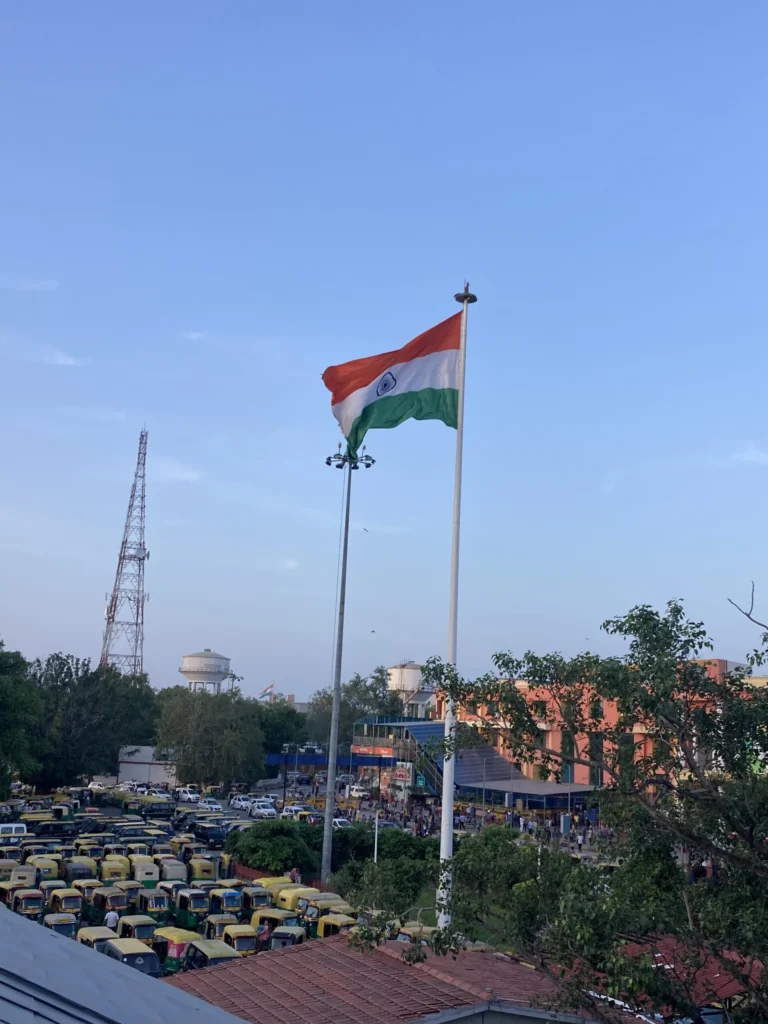 Arriving to Delhi
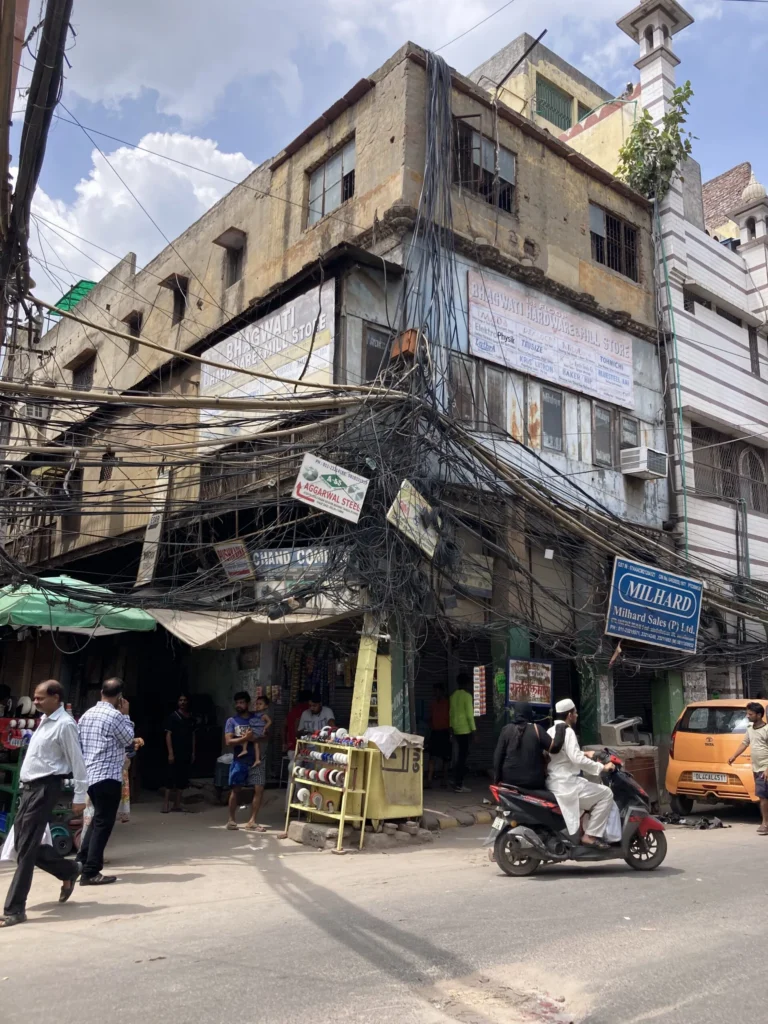 Tangled power lines in Delhi
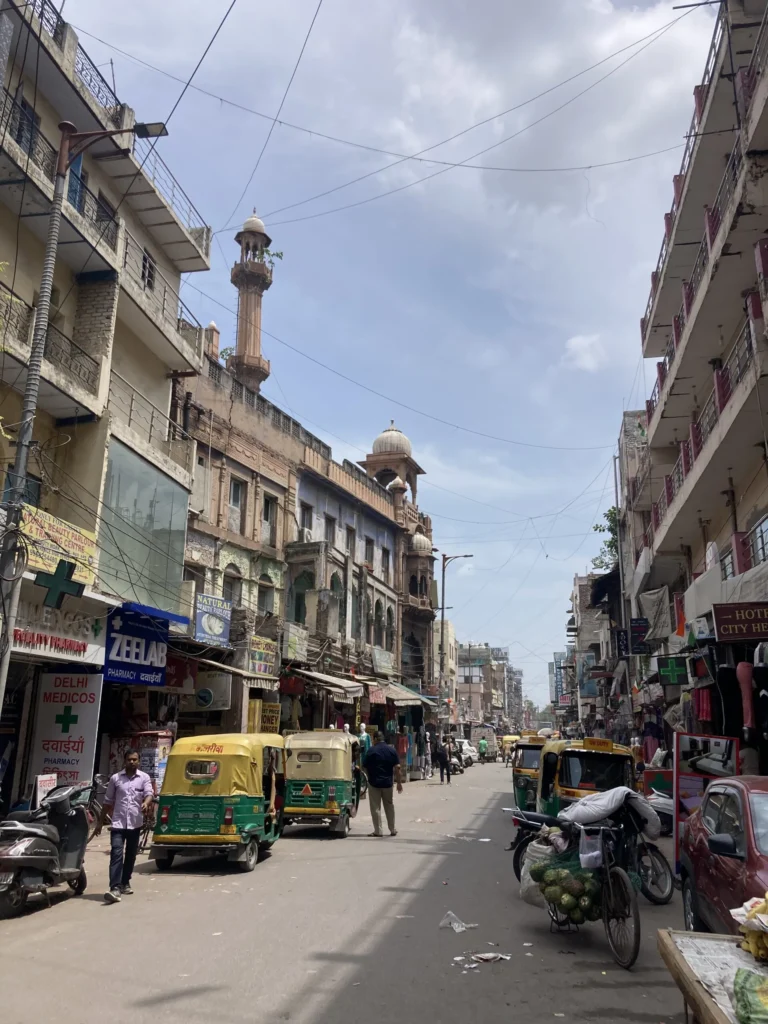 Old Delhi Streets
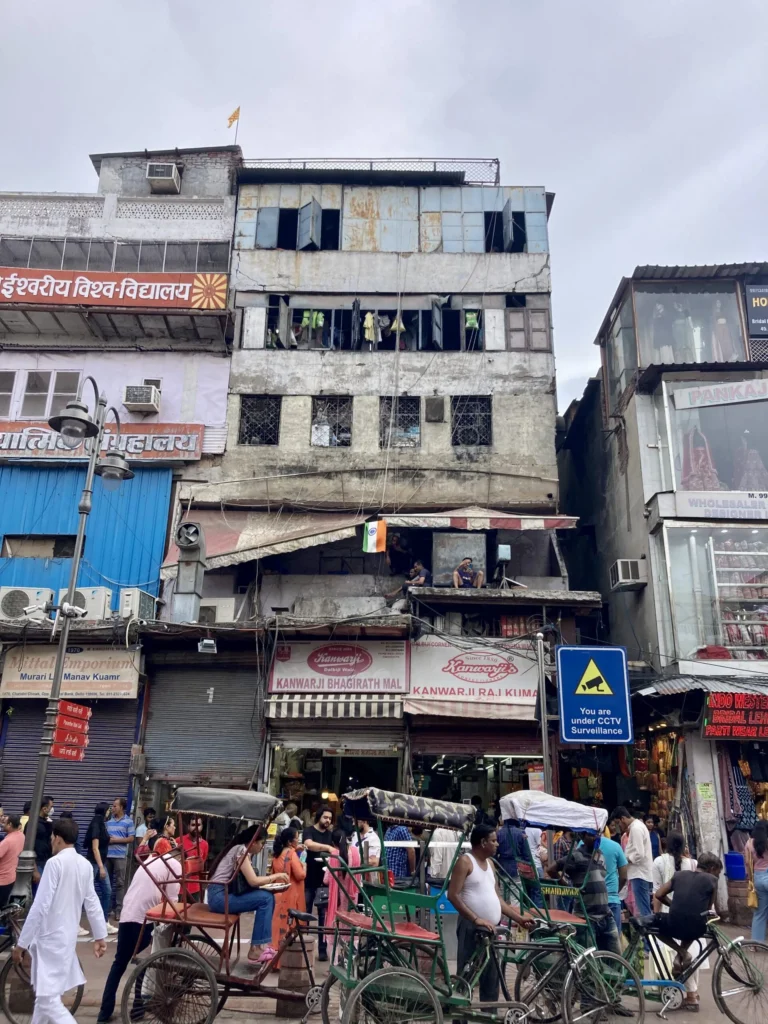 Old Delhi Neighborhoods
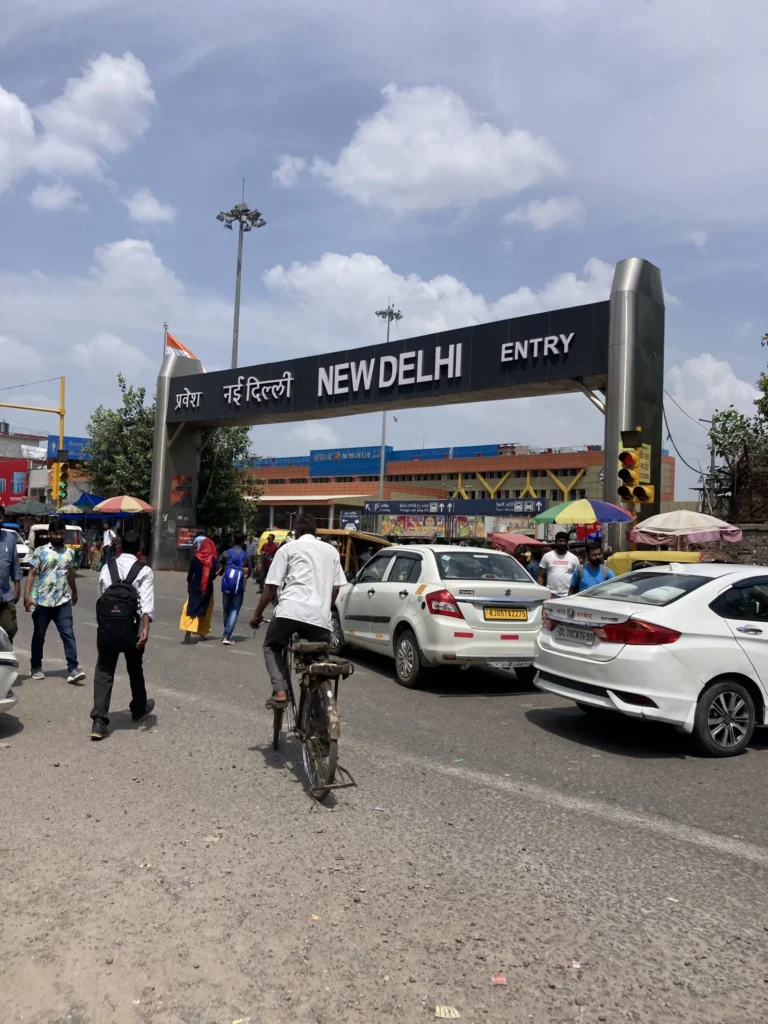 Entrace to New Delhi center
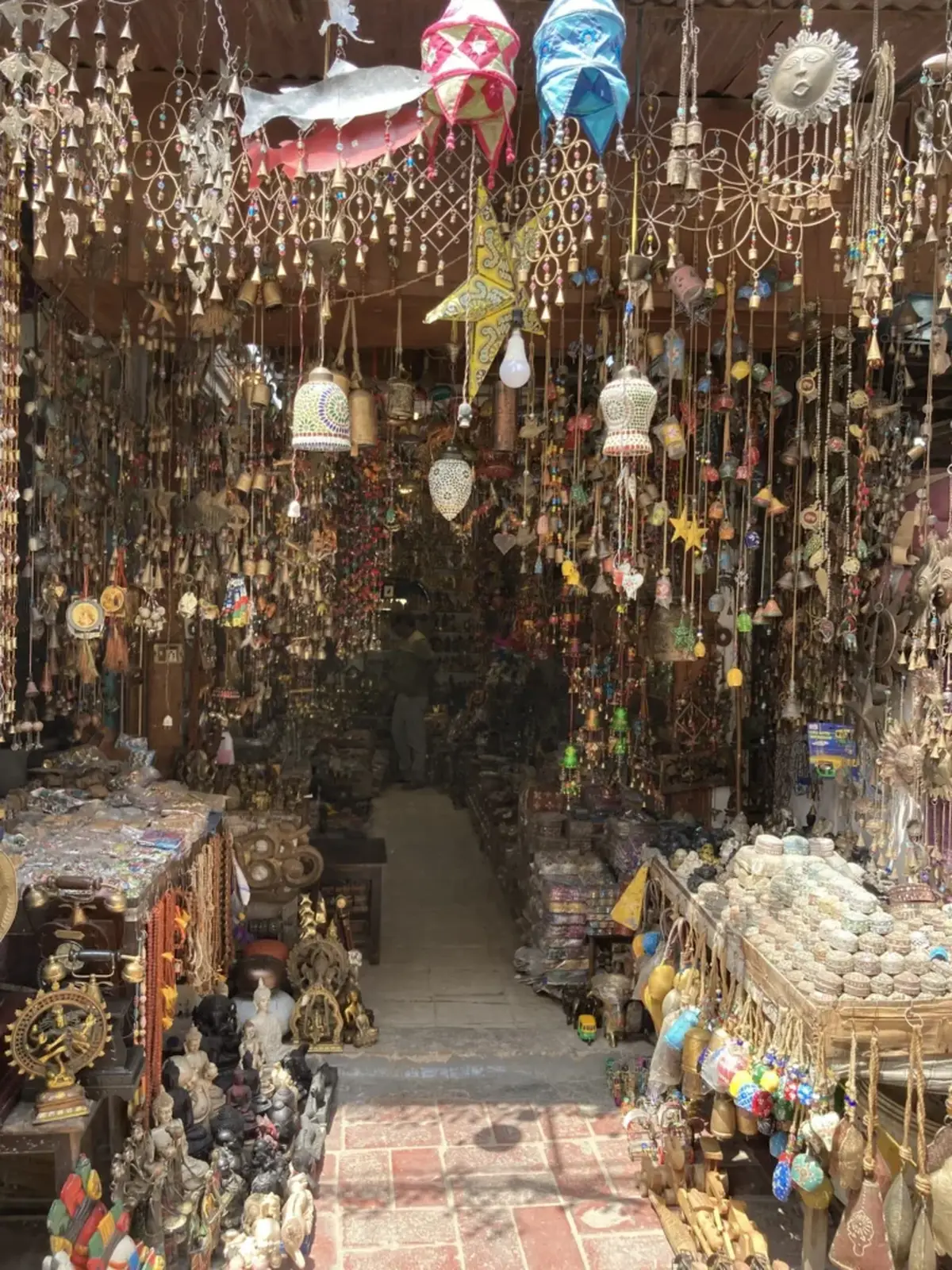 Local shops in Delhi
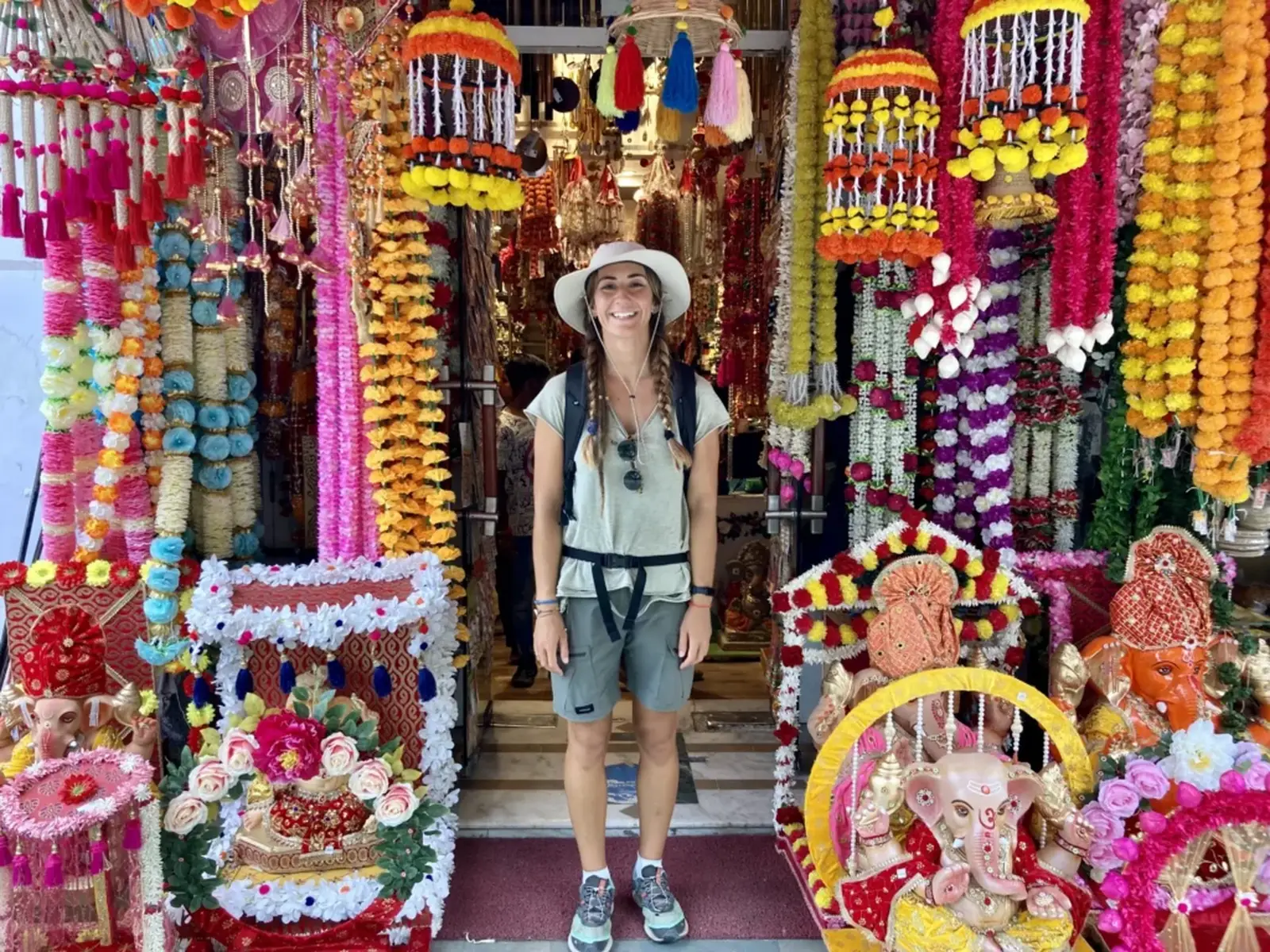 Local shops in Delhi
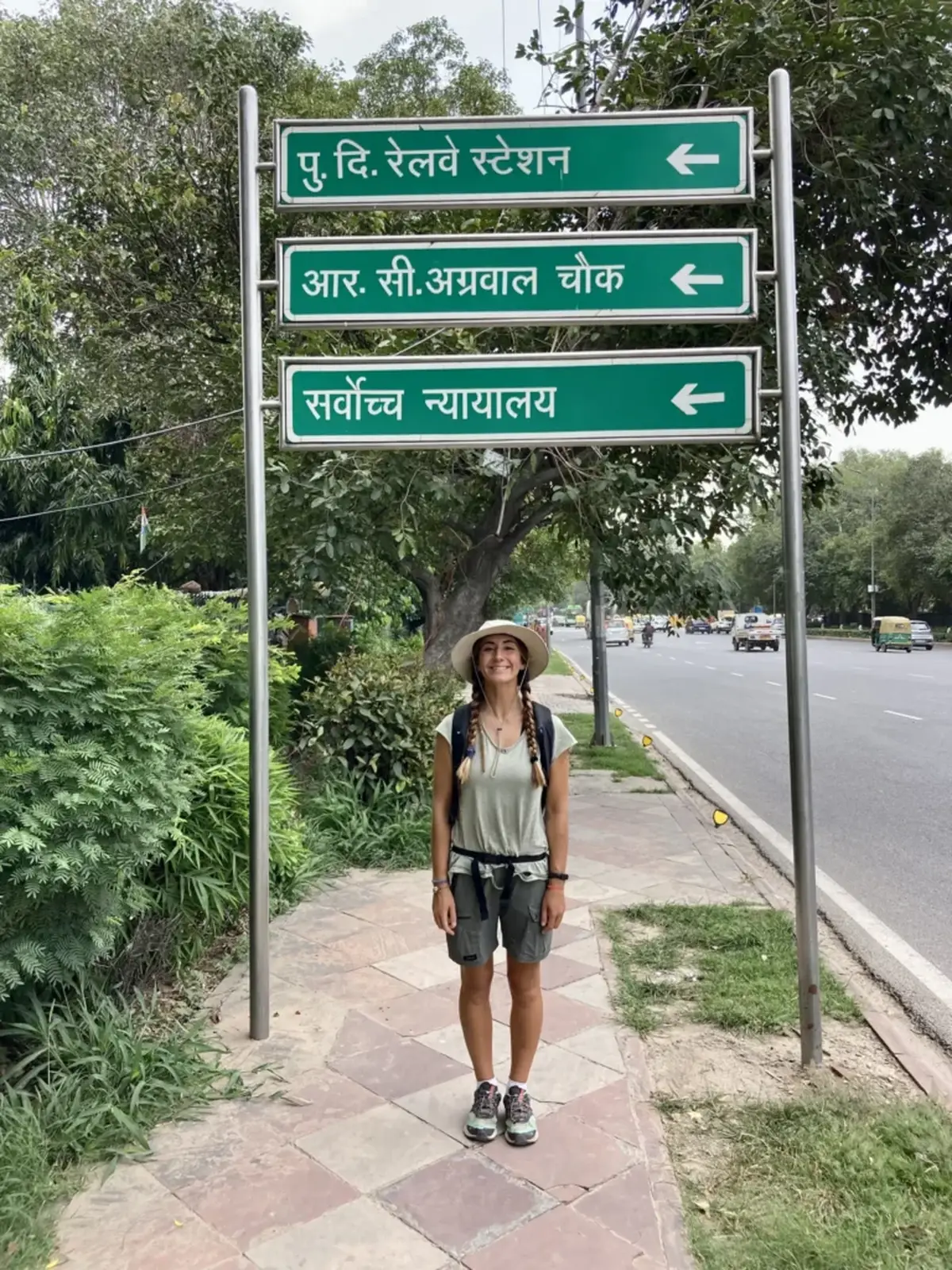 Traffic signals in Delhi
Varanasi: The Holy City and Its Dead
The night train to Varanasi was a test of endurance. Traveling in sleeper class is not a comfortable experience: open compartments, fans hanging from the ceiling, crying children, people shouting to sell chai, and a constant mix of smells that are hard to describe. We barely slept. We moved to the rhythm of the clattering tracks, clutching our backpacks, with heat and dust sticking to our skin.
We arrived in the morning, dazed. As soon as we stepped out of the station, Varanasi hit us full force. Dense heat, suffocating humidity, and traffic that felt like an impossible choreography of motorbikes, cows, tuk-tuks, and people. We took a rickshaw to the center, but the driver didn’t know how to get to our accommodation, so we ended up walking with our packs on our backs through a labyrinth of narrow, dirty, and foul-smelling alleys, many of them flooded up to our ankles.
Google Maps was useless. The streets weren’t properly mapped and the GPS signal jumped around aimlessly. After several frustrated attempts, we managed to reach the Bhadrakali Guesthouse, a modest place but with a privileged location: our window looked directly out onto the Ganges. There it was—massive, brown, motionless, as if it were a sea instead of a river. We dropped our bags and stood in silence for a few seconds. We were in one of the oldest and holiest places in the world. And you could feel it.
That same day, we went out to explore the ghats. The air was thick, smelling of incense, trash, and something else harder to identify. We walked to Manikarnika Ghat, the most famous site for cremations. We saw three bodies burning at the same time, placed on carefully arranged piles of wood. The silhouettes were clear. You could see the limbs, the head, the hair. One man watched the fire while another added wood. No one was crying. No one was screaming. It was something everyday, almost ceremonial.
A few meters from the flames, children played barefoot with an old ball, laughing and running among dogs and ash. The contrast left us speechless. Suddenly, an old man appeared who had recommended a breakfast spot to us that morning. He greeted us familiarly and began explaining the cremation process in great detail. At first, he sounded sincere. But it soon became clear he wanted money. When we told him so, his attitude changed. We left feeling uncomfortable, with that mix of guilt, anger, and distrust that India generates so easily.
In the afternoon, we visited the Benares Hindu University, a massive campus with temples and gardens. The main temple was packed with worshippers. Inside, there was a mix of people praying, pushing, touching statues of gods, chanting mantras, and lighting candles. Everyone moved at once, like a vibrant and overflowing human mass. A chaos of faith that felt overwhelming at times, but also fascinating in its intensity.
At dusk, we headed toward Assi Ghat. It was partially flooded. It had overflowed due to the rains, and the staircase leading down to the river disappeared under the water. We sat down to observe. Around us, elderly people sat in the alleys, many alone, looking fragile. We learned that many come to Varanasi specifically to die there, believing that dying next to the Ganges will liberate them from the cycle of reincarnation.
That night we went to sleep early, emotionally and physically exhausted. Varanasi is not a beautiful place, nor is it comfortable or easy. But it has something magnetic, dense, and raw. A city where life and death coexist without barriers.
Agra: The Taj Mahal and More Trains
After another night on a sleeper train, we had already learned not to expect any rest. The carriage smelled of a mixture of humidity, reheated plastic, and old urine. We slept in fits and starts, in impossible positions, enveloped in noise and heat. Every time the train braked, a gust of dirty air and dust blew in through the open windows. The bathrooms… we’d rather not describe them. Let’s just say it was the worst smell of the entire trip.
We arrived in Agra at dawn. As soon as we stepped off, there were monkeys everywhere—jumping between roofs and cables, stealing bags, and loitering on the platforms as if they were part of the staff. Dragging our backpacks with our bodies completely trashed, all we wanted was to reach the hostel.
We stayed in a modest guesthouse, but it had a terrace with distant views of the Taj Mahal. And that was enough. Seeing that white silhouette standing out among trees and buildings was like a slap of reality. We were in Agra, facing one of the most iconic places on the planet.
After a quick shower and a breakfast of chapatis and chai, we went to Joney’s Place, a tiny, unpretentious restaurant with a hand-written menu on the wall and a friendly cook who asked us a thousand times if we liked the food. We ordered a mild curry and a banana lassi that brought our energy back.
And then, finally, we went to the Taj Mahal.
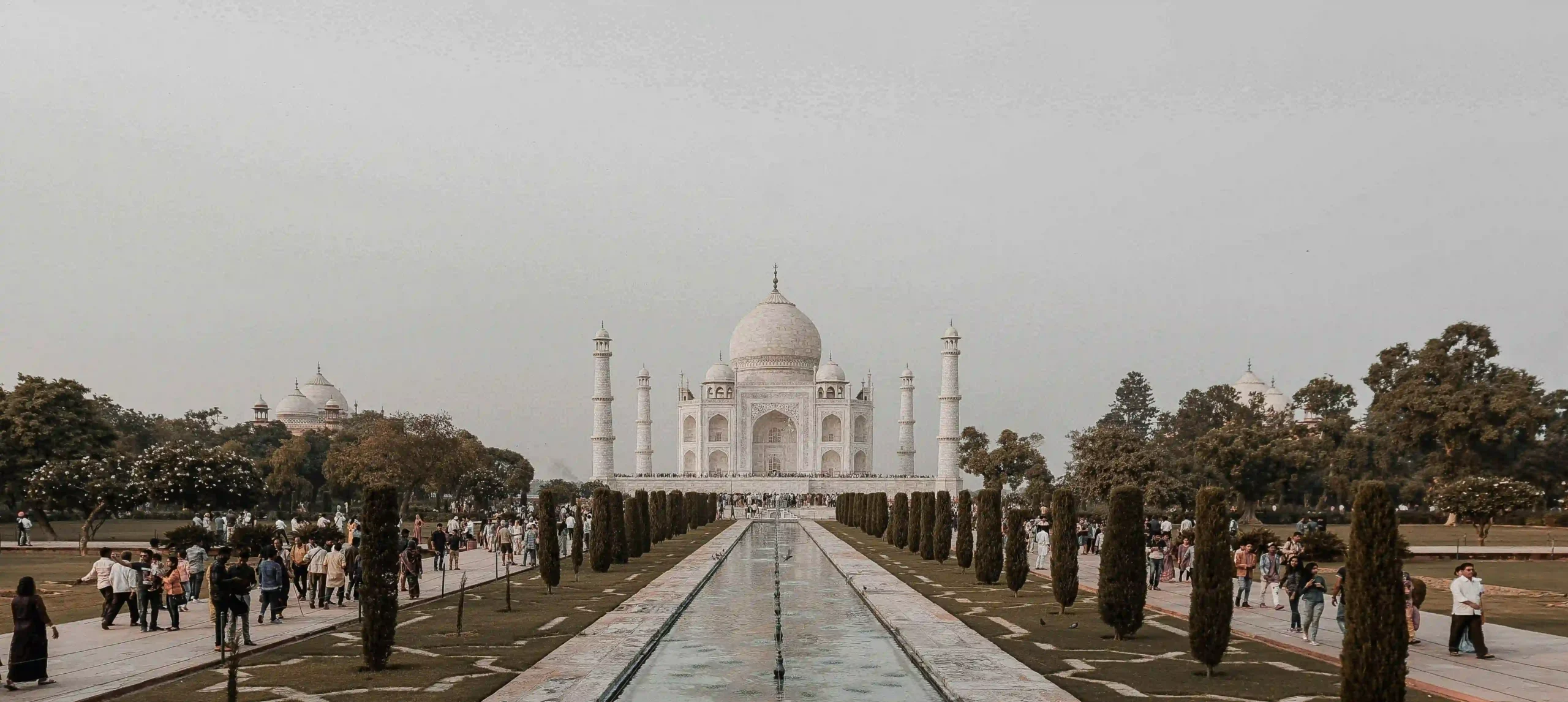
Walking through the main gate and seeing the monument appear suddenly—white, perfectly symmetrical, floating between gardens and fountains—is an image that is not easily erased. Everything they say about the Taj Mahal is true: it is impressive, hypnotic, unreal. It glows with a soft light even under the harshest sun, as if it didn’t belong to the real world. We stayed there for over four hours, sitting, walking, simply observing.
As often happens in India, there was a surreal moment. An Indian woman approached us and, without a word, placed her baby in our arms to take a photo with us. Then others came—with their husbands, children, uncles… we posed as if we were an attraction. We laughed, but it also left us bewildered.
The interior of the Taj Mahal was darker and more crowded with tourists than we expected, but the exterior made up for everything. Upon leaving, still floating in the feeling of having experienced something unique, we walked through the nearby market and bought some local sweets—a kind of dough soaked in syrup that tasted like overheated perfume. We couldn’t even finish them.
At sunset, we returned to our hostel terrace. We sat on the floor, legs dangling over the edge, watching the Taj Mahal turn pink with the setting sun. The heat slowly subsided. In the air remained that Indian blend of smoke, incense, spices, and distant noise.
Agra struck us as a chaotic and ugly city, full of rubble, dust, and traffic, but that building… it changed everything. For a few hours, beauty triumphed over exhaustion.
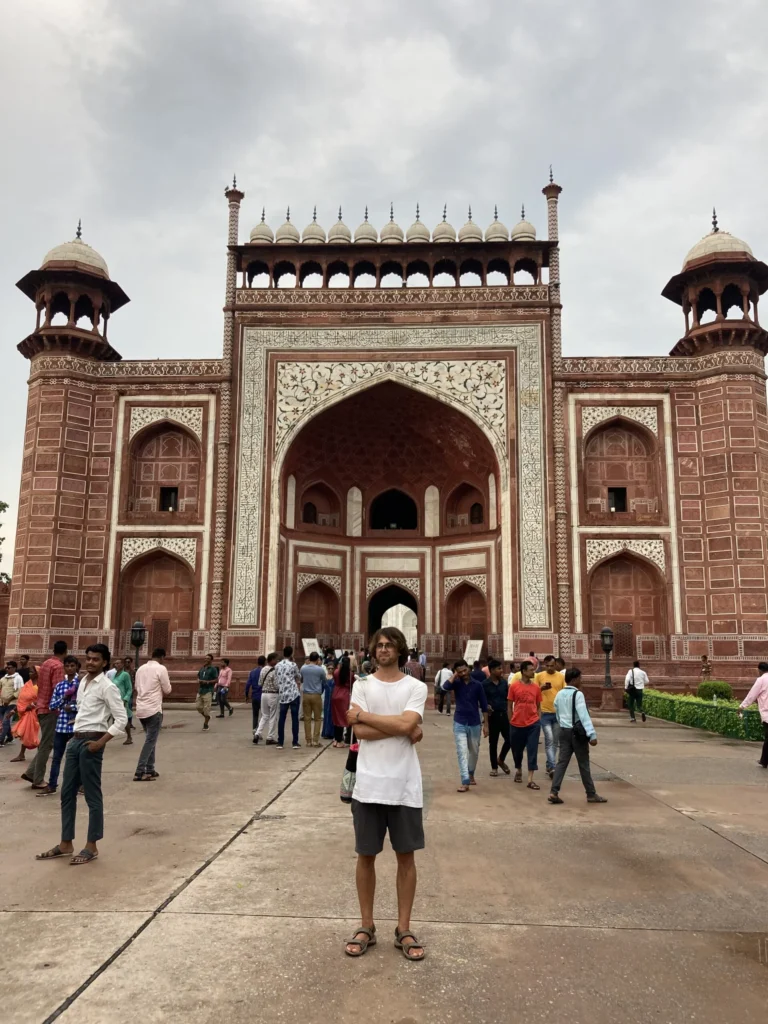 Taj Mahal Entrance
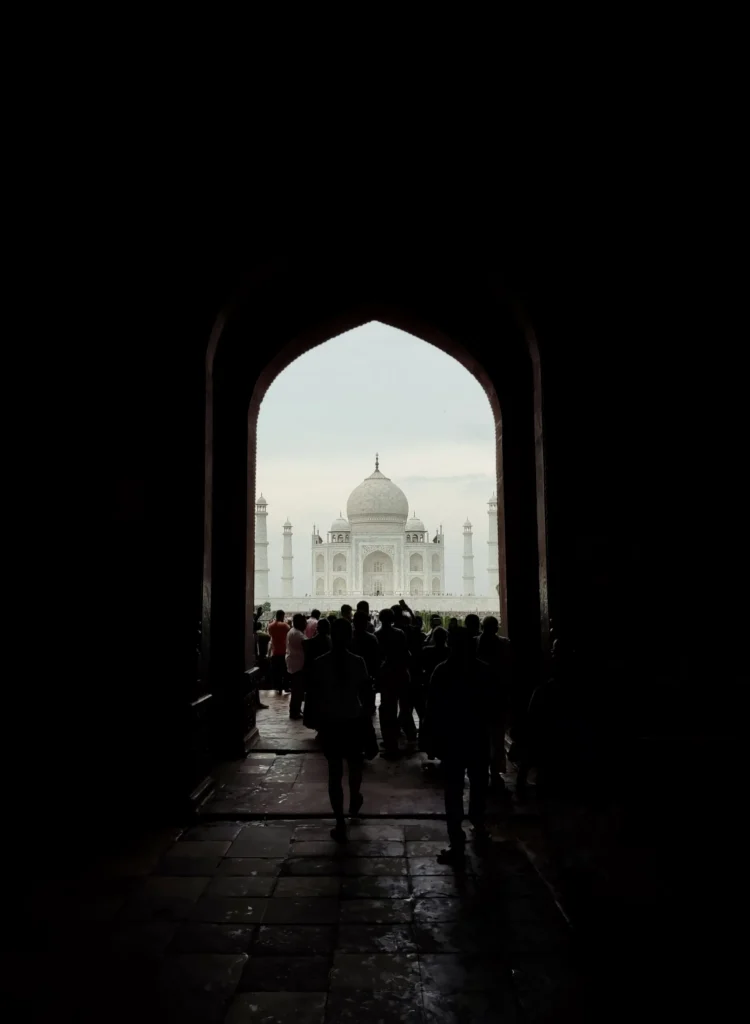 Taj Mahal
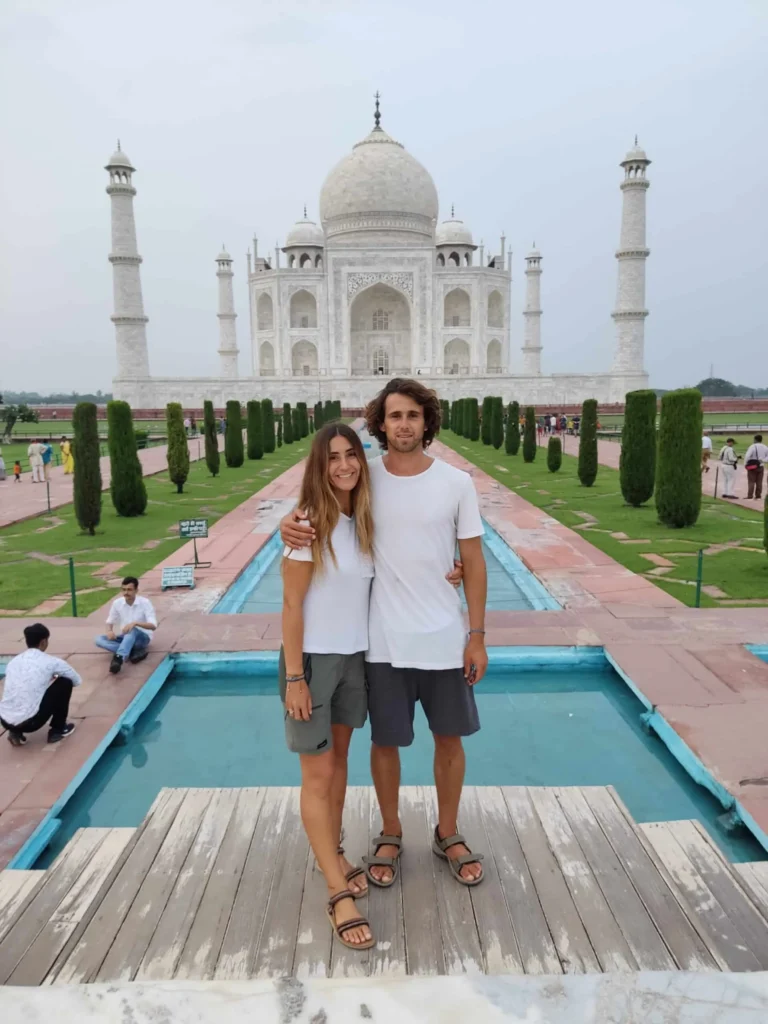 Taj Mahal
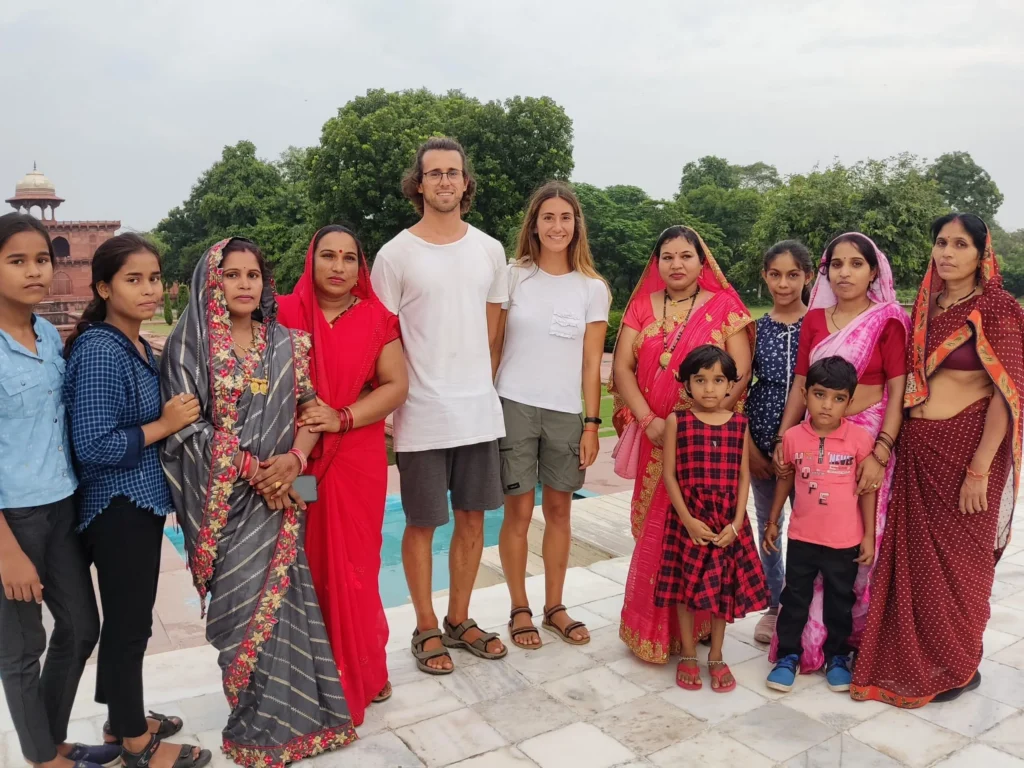 Photos with local families at Taj Mahal
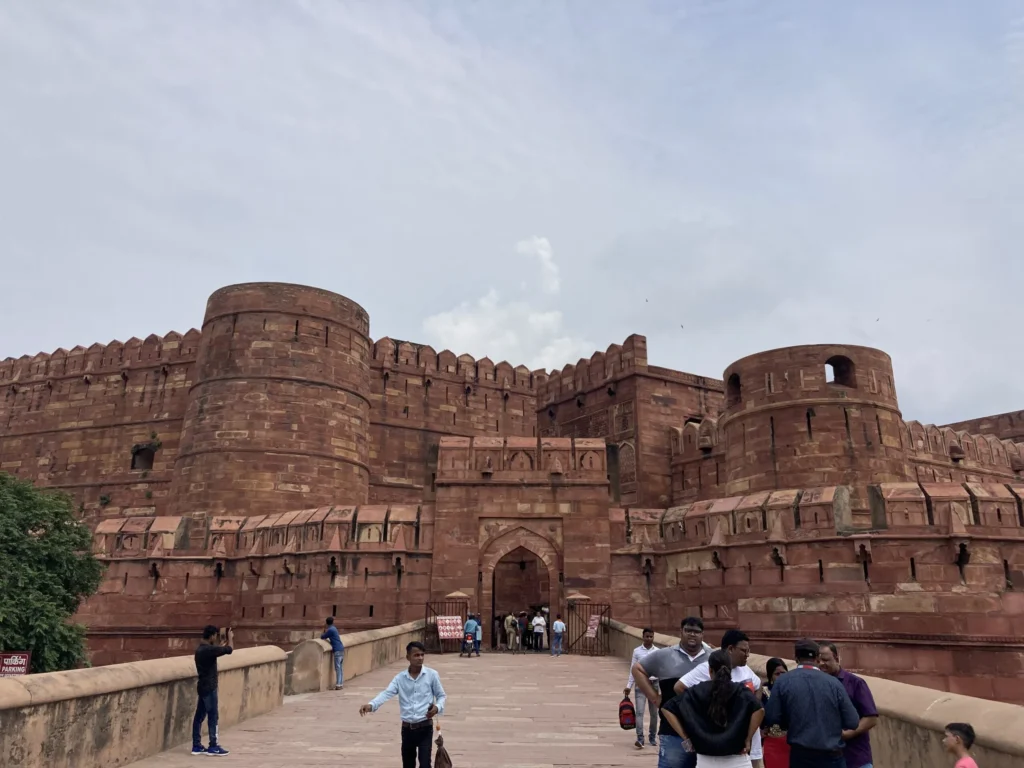 Agra Fort
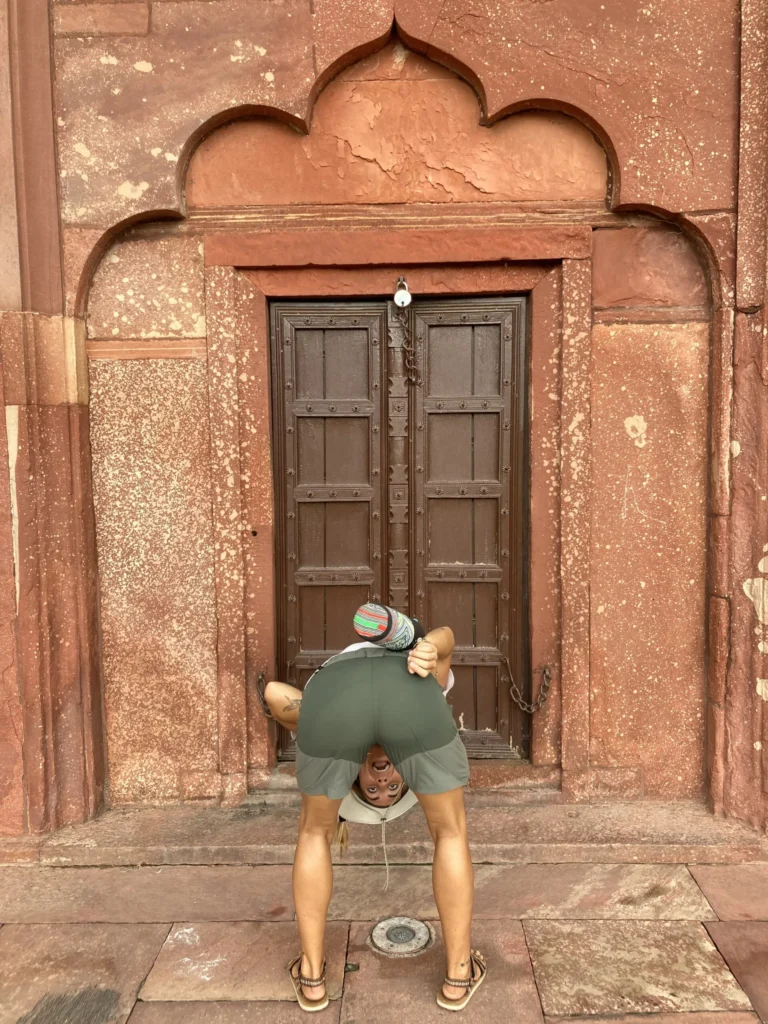 Agra Fort
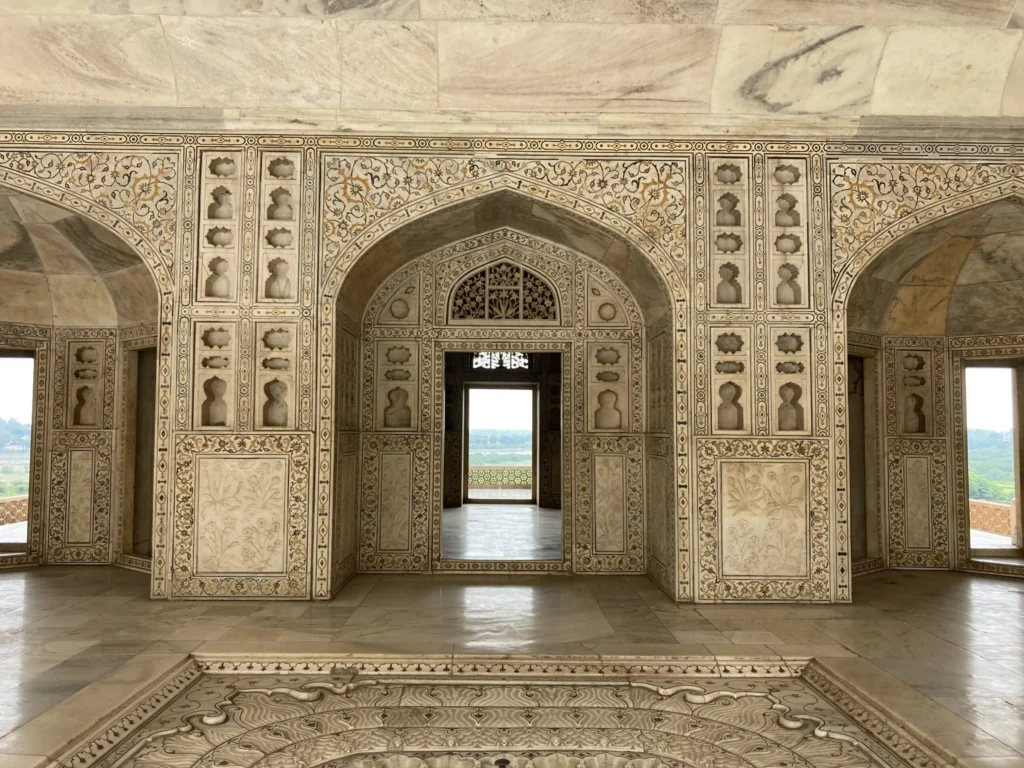 Agra Fort
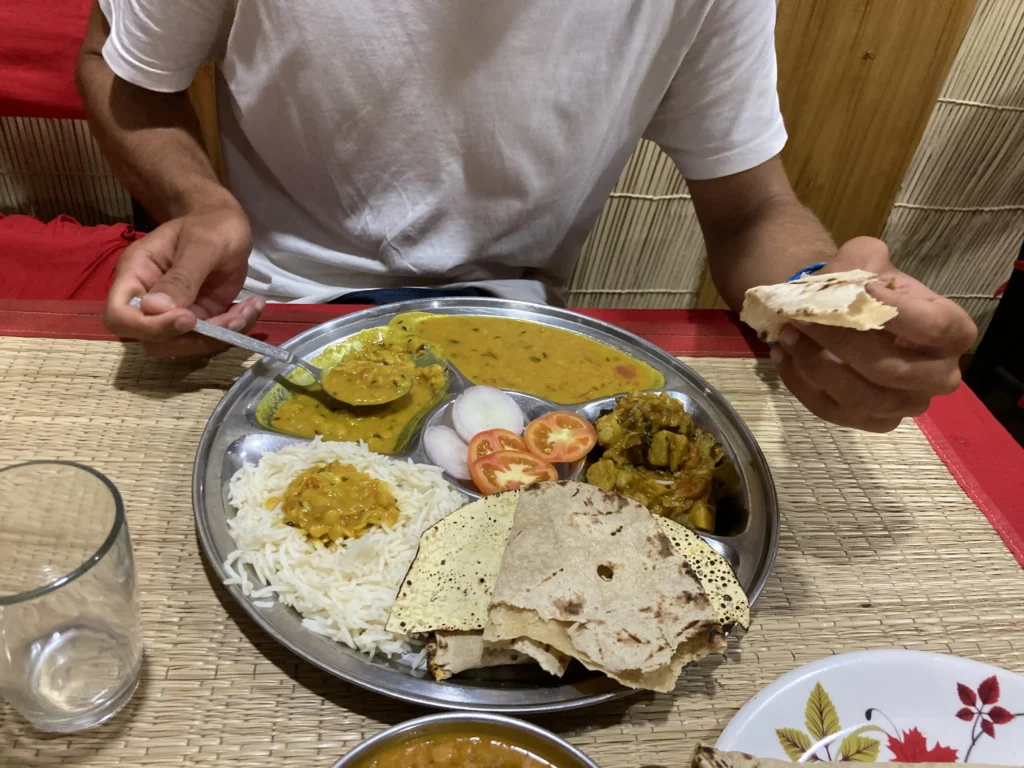 Local food in Agra
Jaipur and Ajmer: Fortresses and Temples
After visiting the Agra Fort in the morning—imposing, but with a heat that made it hard to concentrate—we took a second-class train to Jaipur, the capital of Rajasthan. The journey was somewhat quieter than usual, with fewer people and less chaos… until we arrived.
The hostel we had booked promised more than it delivered. The photos showed a colorful and traditional place; the reality was a sweltering room with a ceiling fan hanging from a wire that was scary to look at, a bathroom that barely worked, and a general sense of neglect. But after several days in India, our expectations had already adjusted. The important thing was that it would let us sleep.
And the next day, Jaipur won us over completely.
We started early, taking a tuk-tuk toward Ajmer, an ancient walled town on the outskirts of the city. Even from the road, amidst the dust and constant honking, you could see the walls snaking through the hills, climbing up ridges and surrounding fortresses. We walked up among tourists, monkeys, sleeping dogs, and the occasional persistent vendor. With every step, the view expanded, and from the top of the Ajmer Fort, the dry and reddish landscape of Rajasthan stretched out like a sea of dust dotted with fortresses.
Between the temples, the carved stone walls, and the shadowy passages, we saw monkey fights echoing between the walls. Some tourists pulled away; others pulled out their phones recklessly. We watched from a distance, not moving much, trying to imagine what that place would have been like centuries ago when it was the residence of the Maharajas.
We returned to Jaipur hungry and hot. We tried an onion dosa in a simple spot in the old city. The crispy dough, the mild spices, the coconut chutney. Later, for dinner, we sat on a terrace full of fans spinning to the rhythm of the heat and ordered a chicken tandoori and a paneer with naan that, for the first time in many days, made us feel satisfied without the risk of a stomach explosion. It was hard to tell if the food was actually good or if it was just our stomachs regaining hope.
We strolled through the markets. Jaipur is known as the Pink City, and its colonial facades tinted in that pastel color give it a particular, even elegant aesthetic—if you squint your eyes to avoid seeing the tangled wires or the trash on the edges.
Among fake jewelry, bright saris, all kinds of crafts, and barefoot children asking for coins, one of the stalls caught our attention: a scale on a dirty rug. A man was shouting, “Only 10 rupees! I tell you your weight!” and there was a queue. People were paying to weigh themselves in the middle of the street. They smiled upon learning their weight. Some seemed proud, others astonished. Paying to know how much you weigh. India.
On one occasion, two men arrived with baskets full of snakes, and without asking, they draped a cobra around Jaime’s neck. Meanwhile, the other played the flute, making more cobras emerge from his basket, while the one on Jaime’s neck moved to the beat of the music. These individuals were whispering to him: “500 rupees minimum for this.” Jaime, after standing paralyzed for a while, and once they removed the snake, got angry and told them he wasn’t going to give them a single cent and to leave…
We walked back to the hostel, crossing a zebra crossing where nobody respected anything, among cows, honks, and motorbikes. In the end, it was still chaos… but for the first time in days, it felt like a friendly chaos.
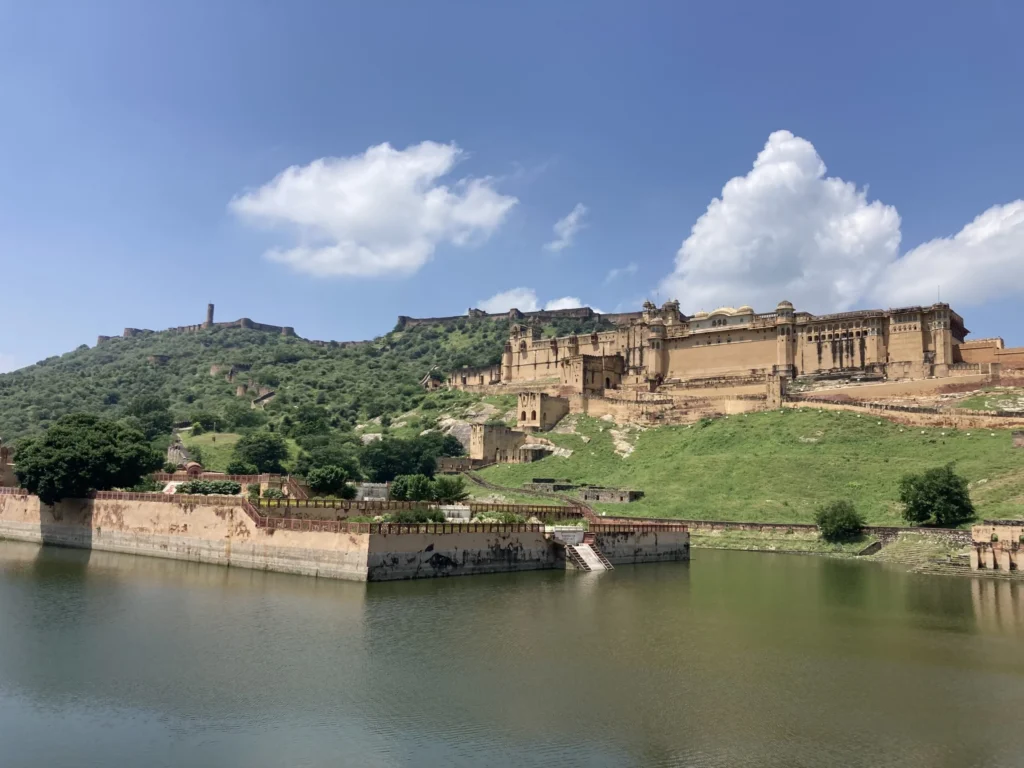 Ajmer
Ajmer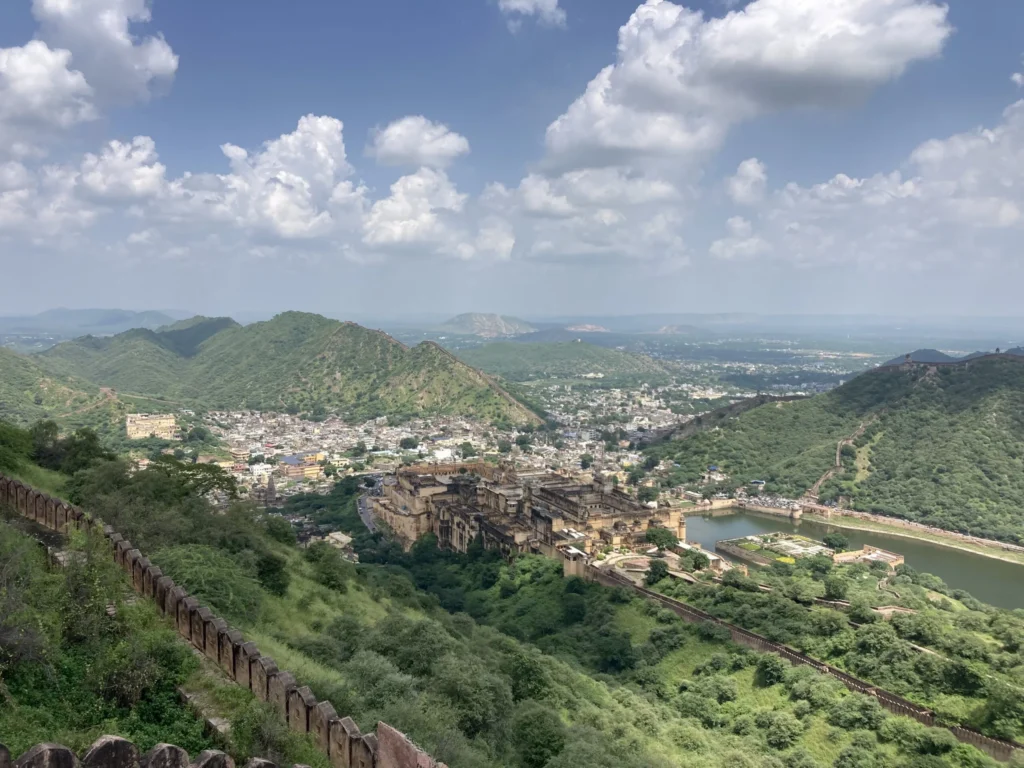 Ajmer
Ajmer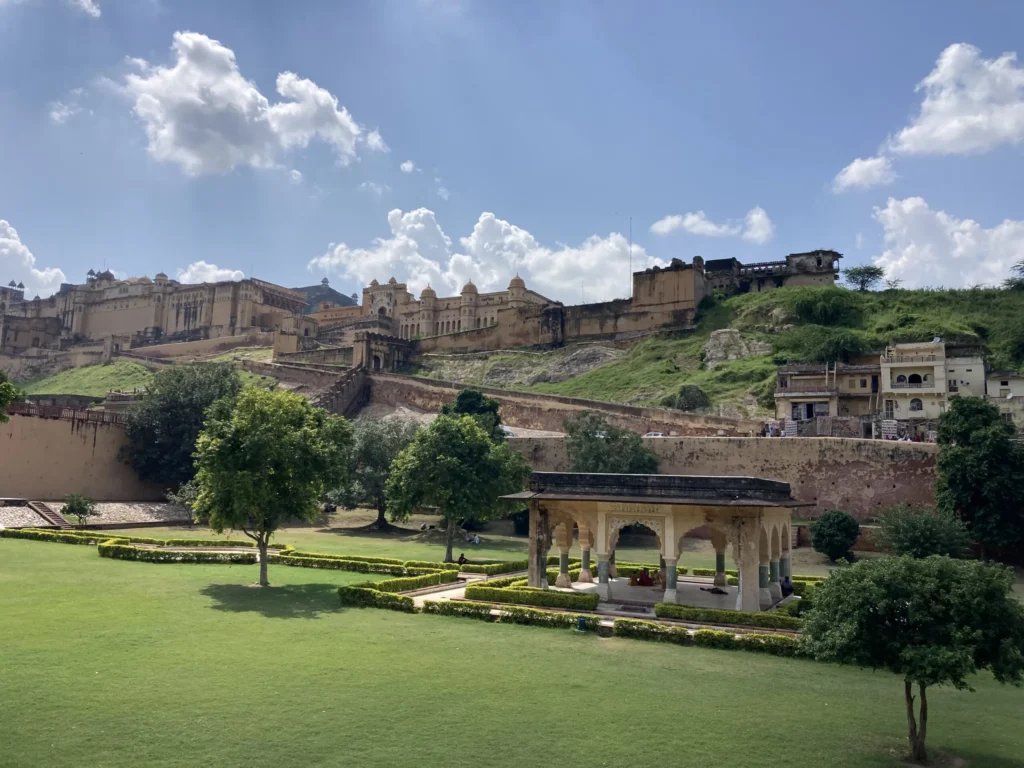 Ajmer
Ajmer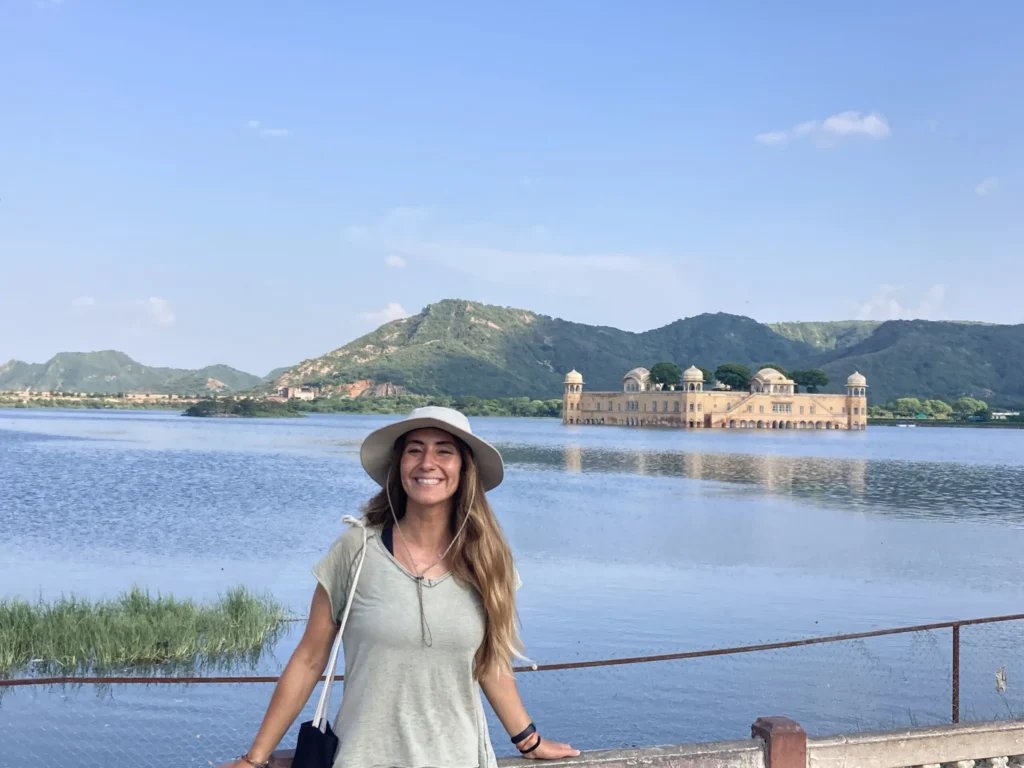 The semi-submerged palace of Ajmer
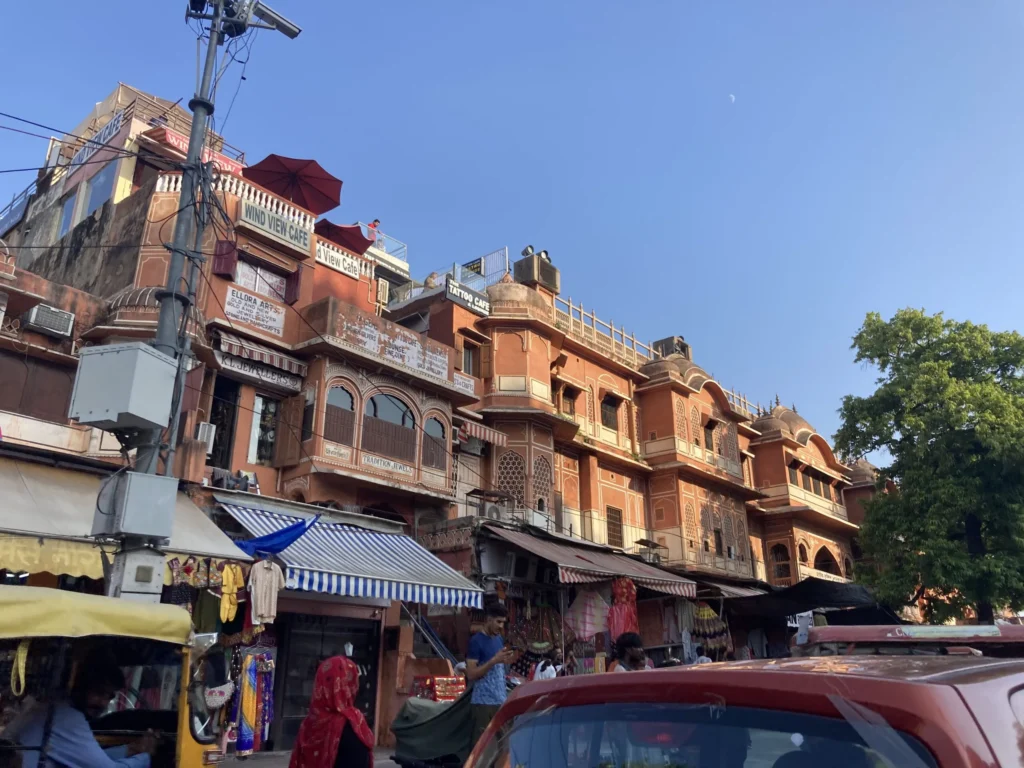 Jaipur
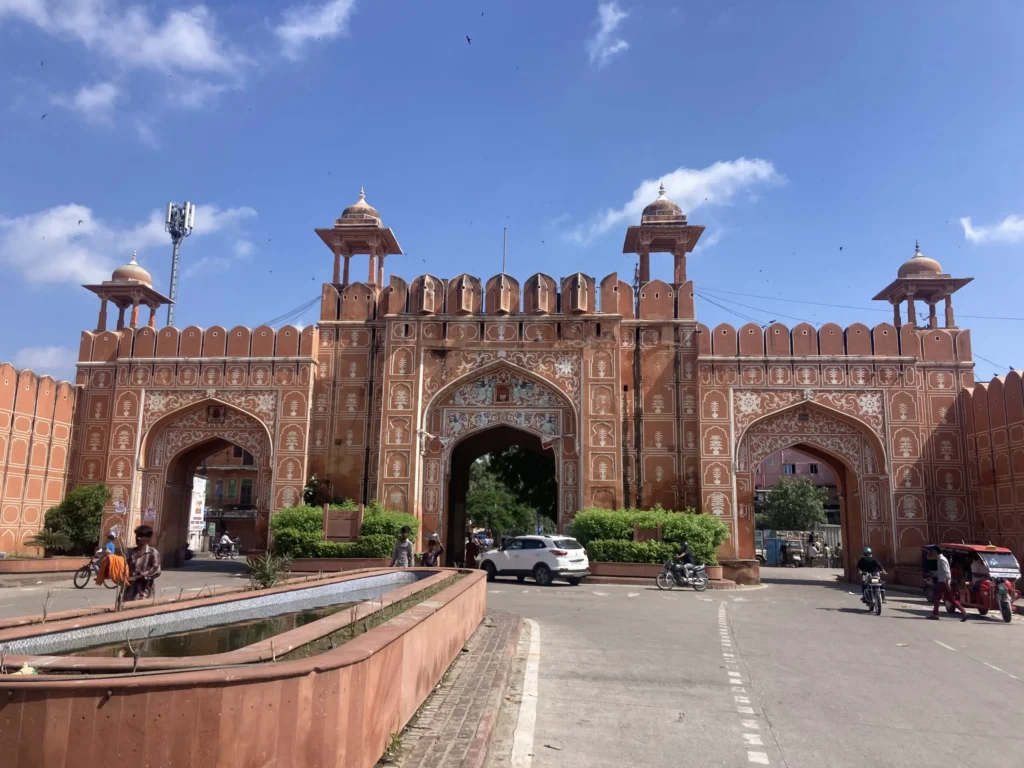 Jaipur
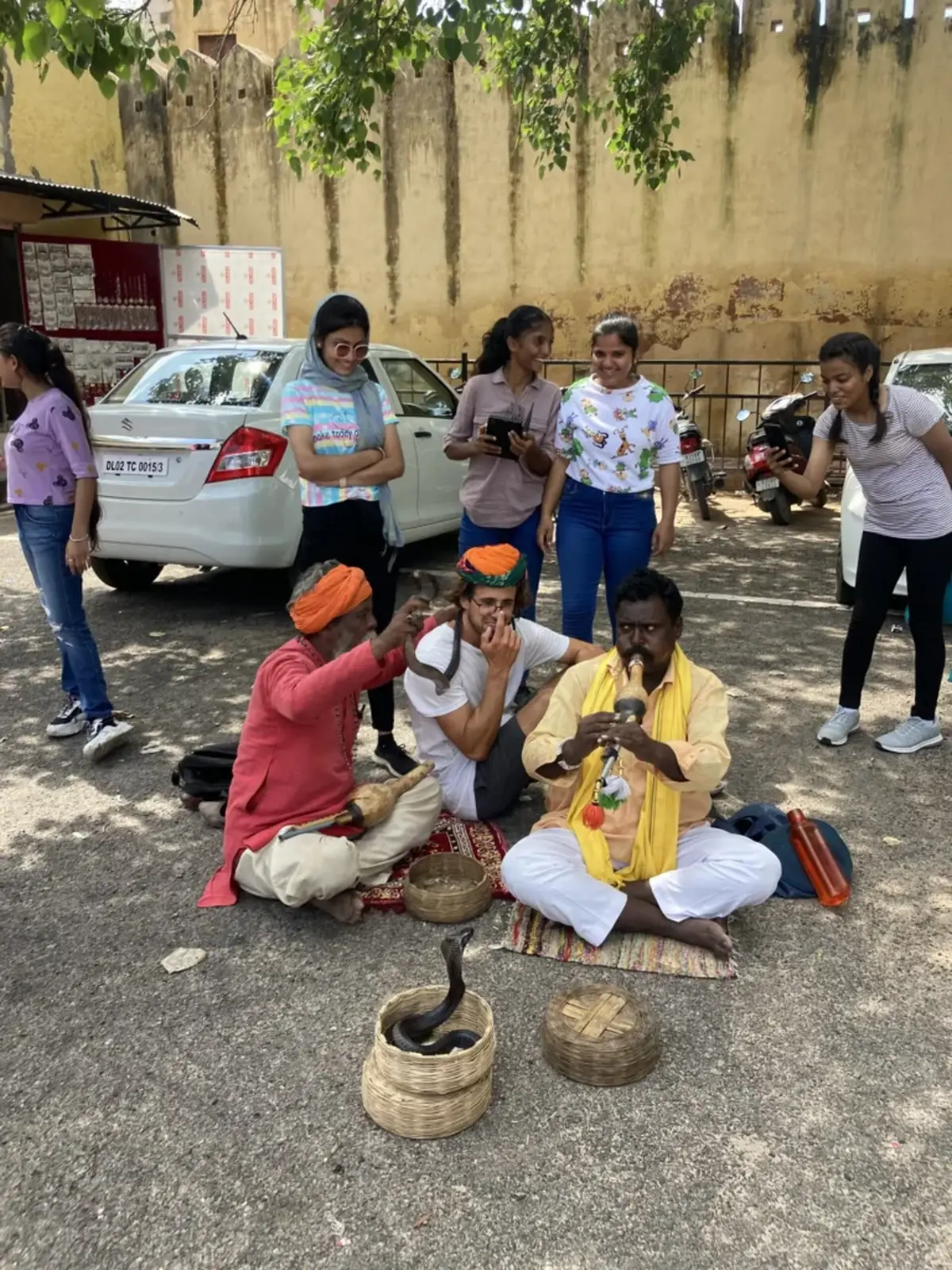 Cobra in Jaime’s neck in Jaipur
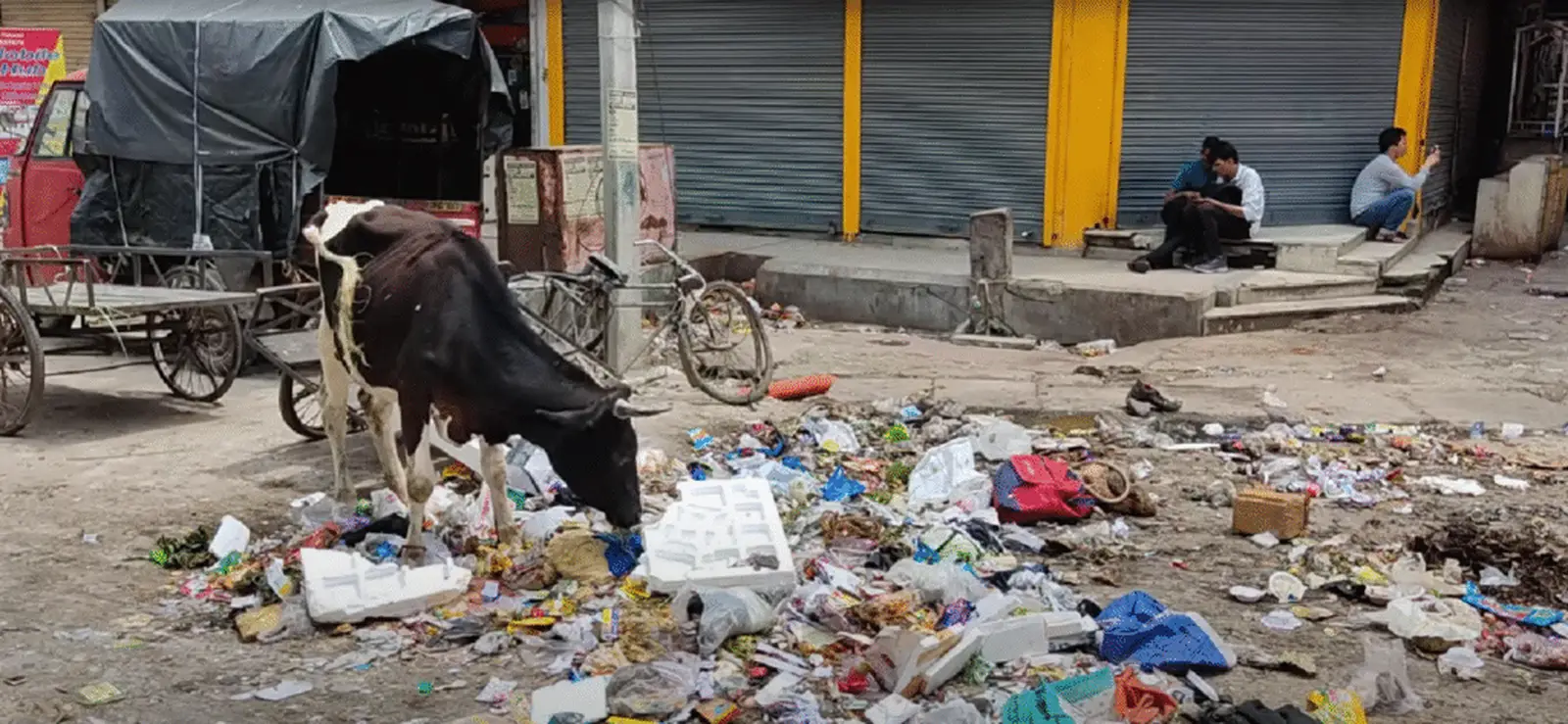 Cown eating from rubbish in Jaipur
Pushkar: Shawarma, Sacred Lakes, and Aggressive Monkeys
After the controlled chaos of Jaipur, we took a short train to Ajmer, and from there a taxi dropped us in Pushkar—a small town surrounded by hills, temples, and a spiritual aura. As soon as we arrived, the atmosphere shifted completely. It was as if someone had turned down the volume on India. Less honking, less shouting, more incense, and more smiles.
Pushkar revolves around its sacred lake, bordered by white ghats and temples. We decided to take it easy and started the day with breakfast at the Buddha Café, a laid-back spot with cushions on the floor, chill music, a slow-spinning ceiling fan, and a waiter with a distant but friendly gaze. The chai came in clay cups, and the walls were covered with half-faded inspirational quotes.
After eating, we took off our shoes and headed down to the ghats. The sun was beating down, and the ground was scorching, but no one seemed to mind. People were praying, others were bathing, and some were simply staring at the water. A man offered to perform a ceremony for our ancestors. We thanked him but kept walking, observing everything from a distance.
In the afternoon, we decided to hike up to the Savitri Devi Temple, perched on top of a hill. You have to climb hundreds of steps, but the views make it worth it. From the summit, Pushkar looked like a circular oasis, with the lake at its center and the entire town in white and earth tones swirling around it. The wind was blowing hard, and it was a welcome relief.
But we didn’t expect the monkeys.
First, we saw a large one watching us from a railing. Then another, smaller one, looking quite grumpy. At first, we laughed. Then, it stopped being funny. One of them suddenly lunged at us, baring its teeth, screeching, and waving its arms as if it were about to attack. In the panic, Jaime slipped and nearly fell down the stairs. I grabbed his arm while we backed away slowly, as if we were facing a wild animal (because, in reality, we were). It was the most tense moment of the day.
After that scare, we headed down more carefully and sought refuge in the quieter part of town. For dinner, we had a shawarma—very popular in Pushkar, where backpackers flock in search of spirituality, yoga, or just some rest. It tasted like heaven.
That same night, we caught a night train to Bundi, leaving behind a place that offered us, in just a few hours, a perfect blend of peace, scares, and chickpeas.
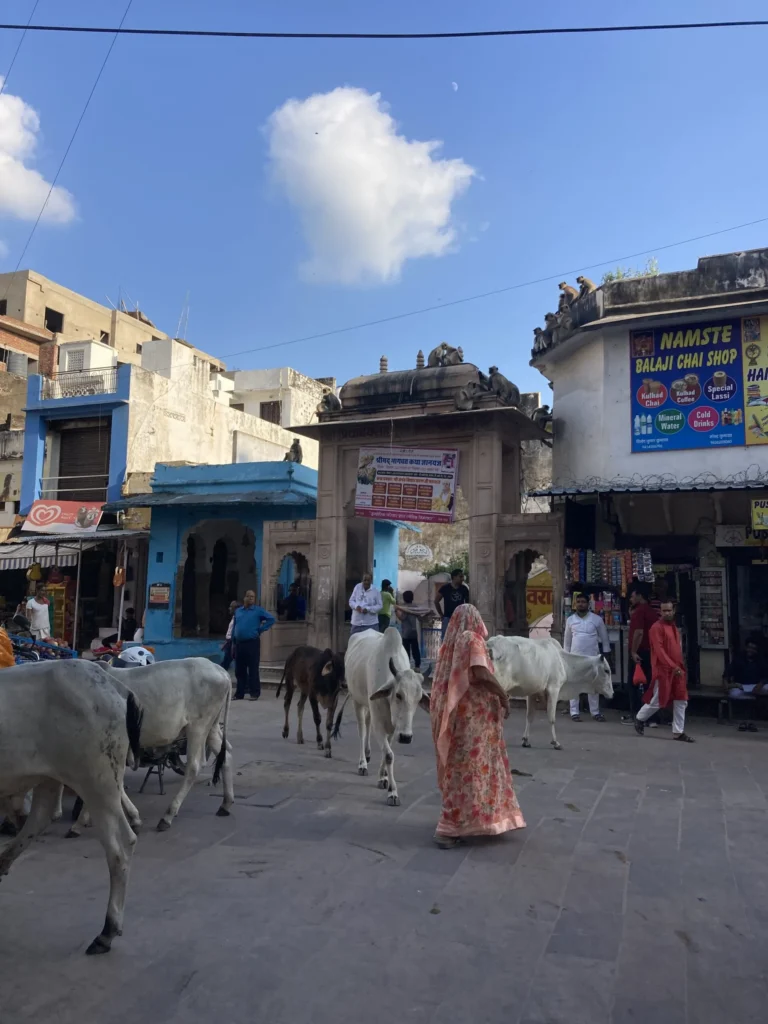 Pushkar
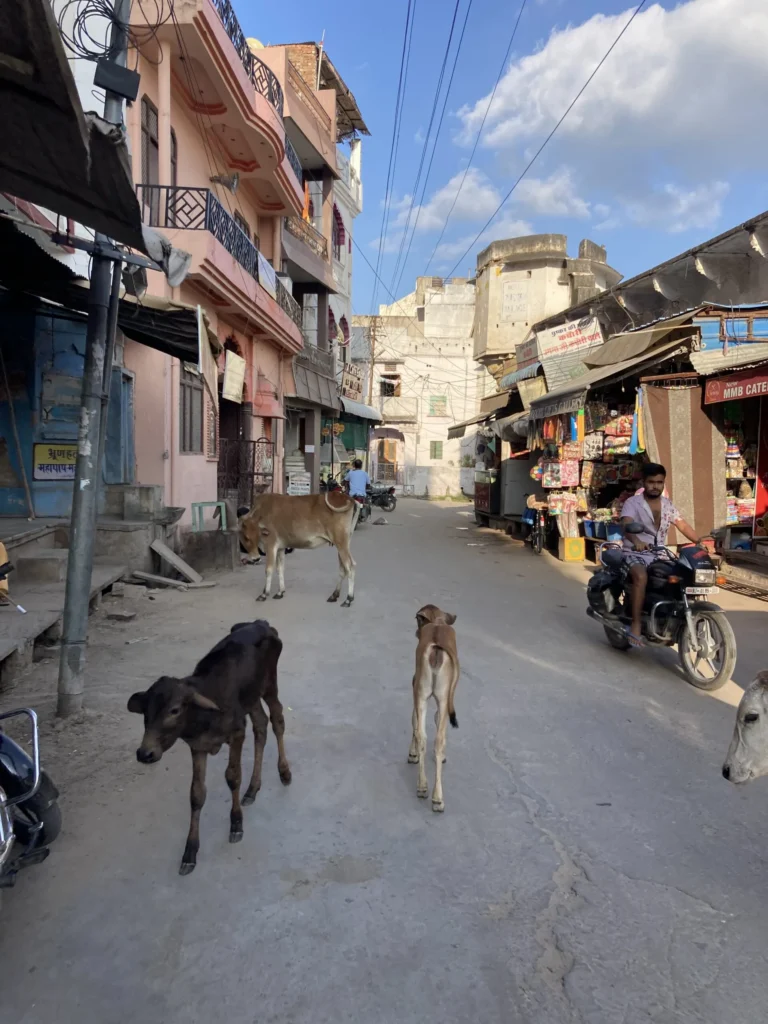 Pushkar
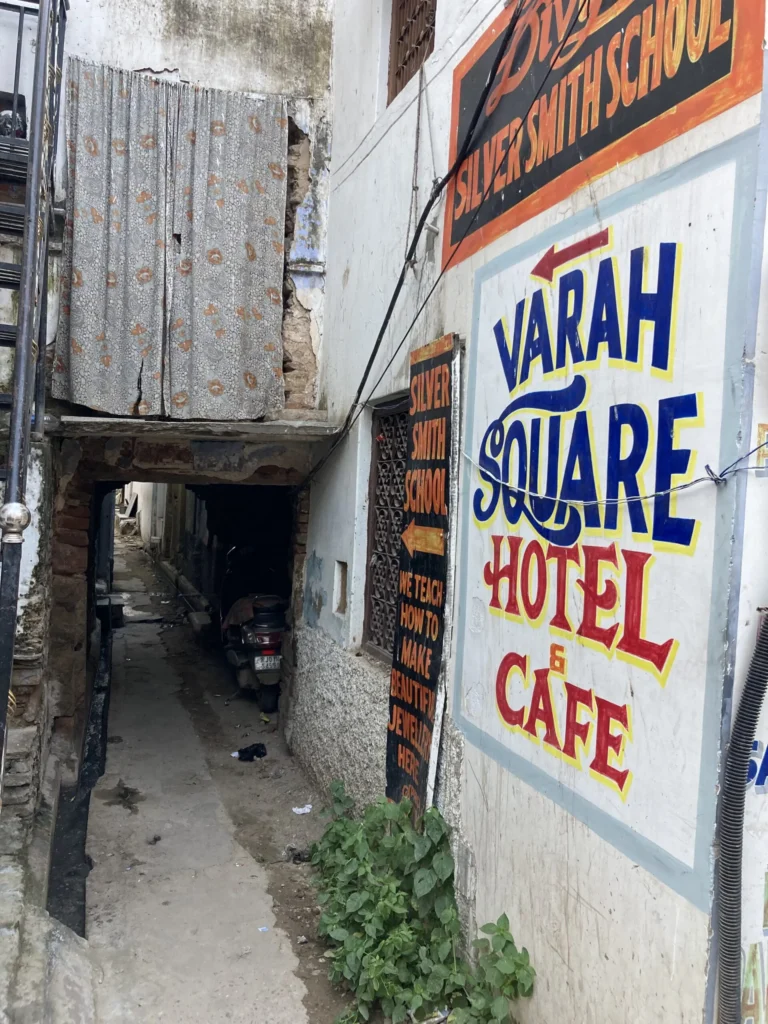 Entrance to our hotel in Pushkar
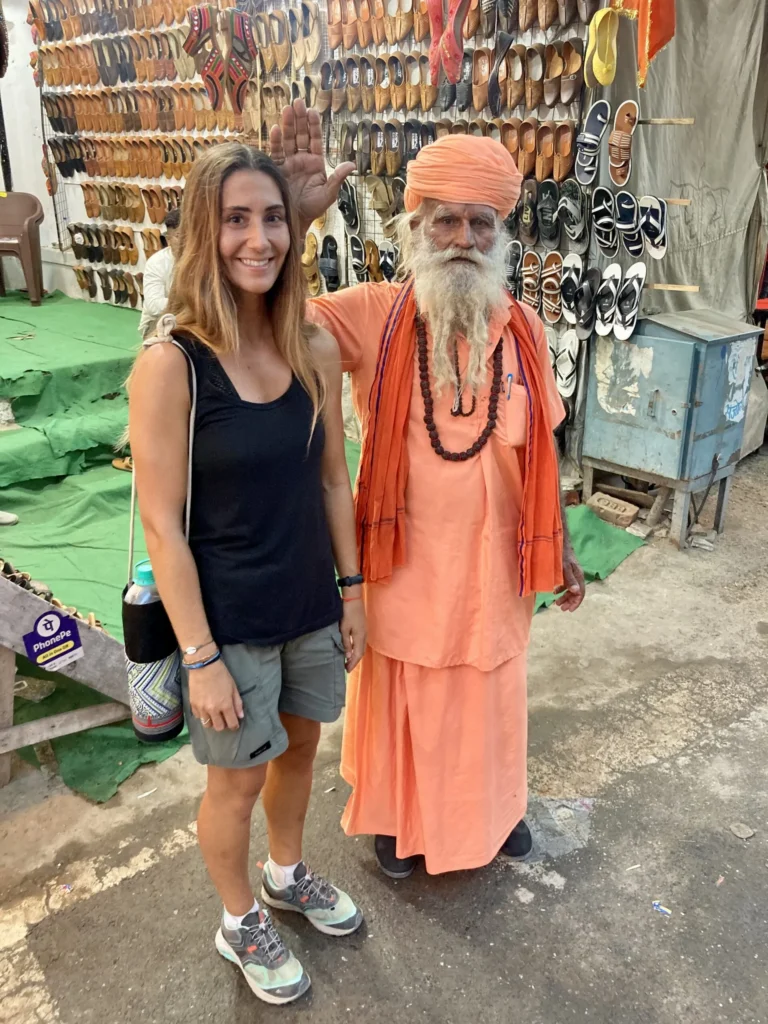 Meeting a Sadhu (holy man) in Pushkar
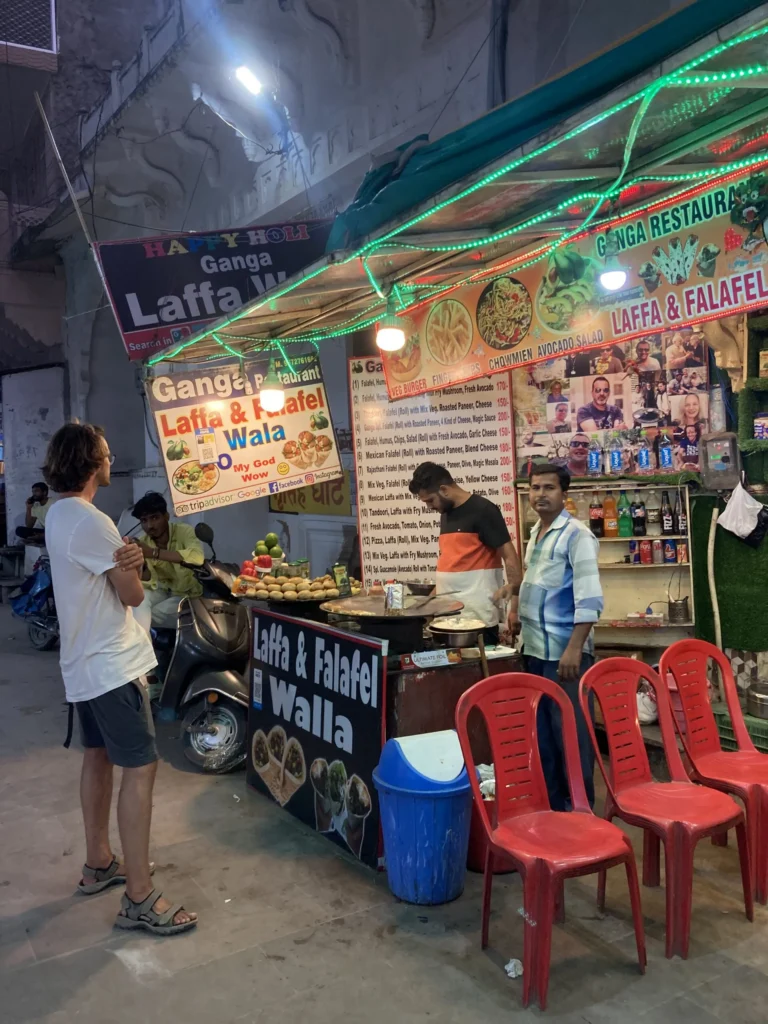 Shawarma DInner
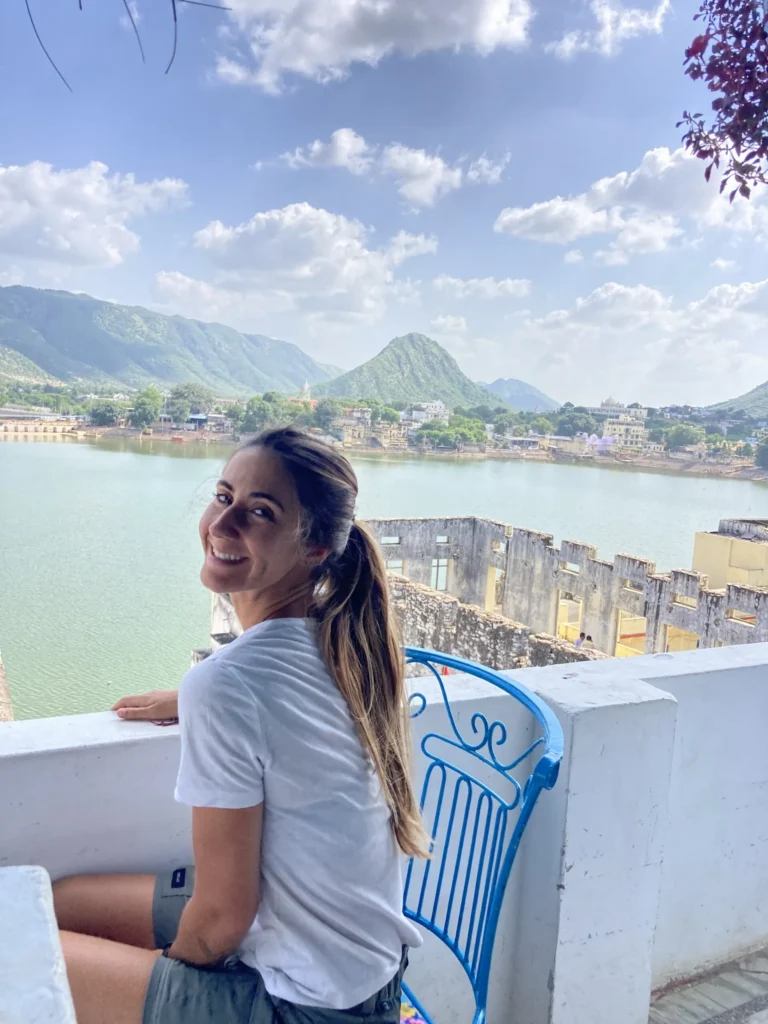 Pushkar
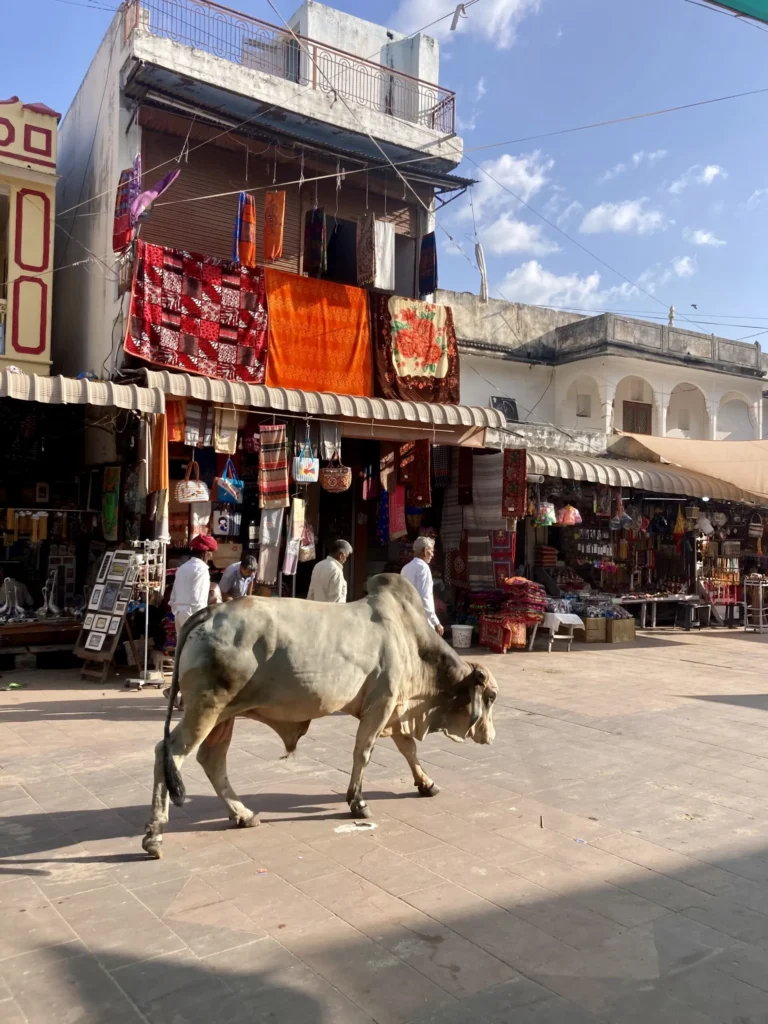 Pushkar
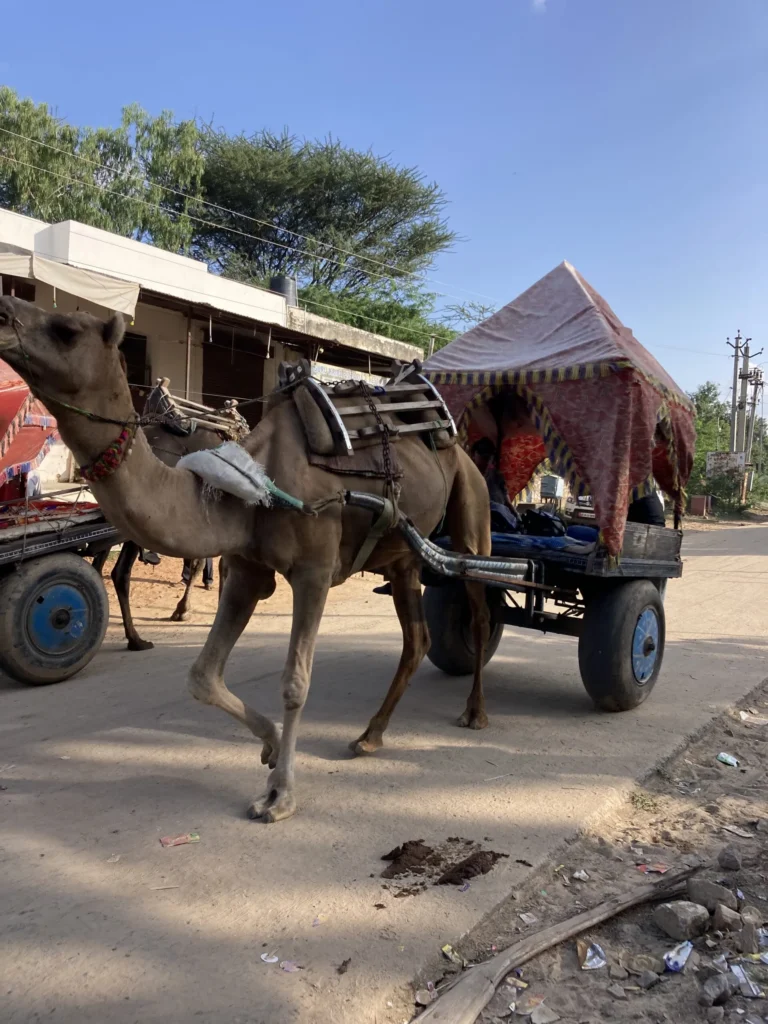 On our way to Savitri Temple
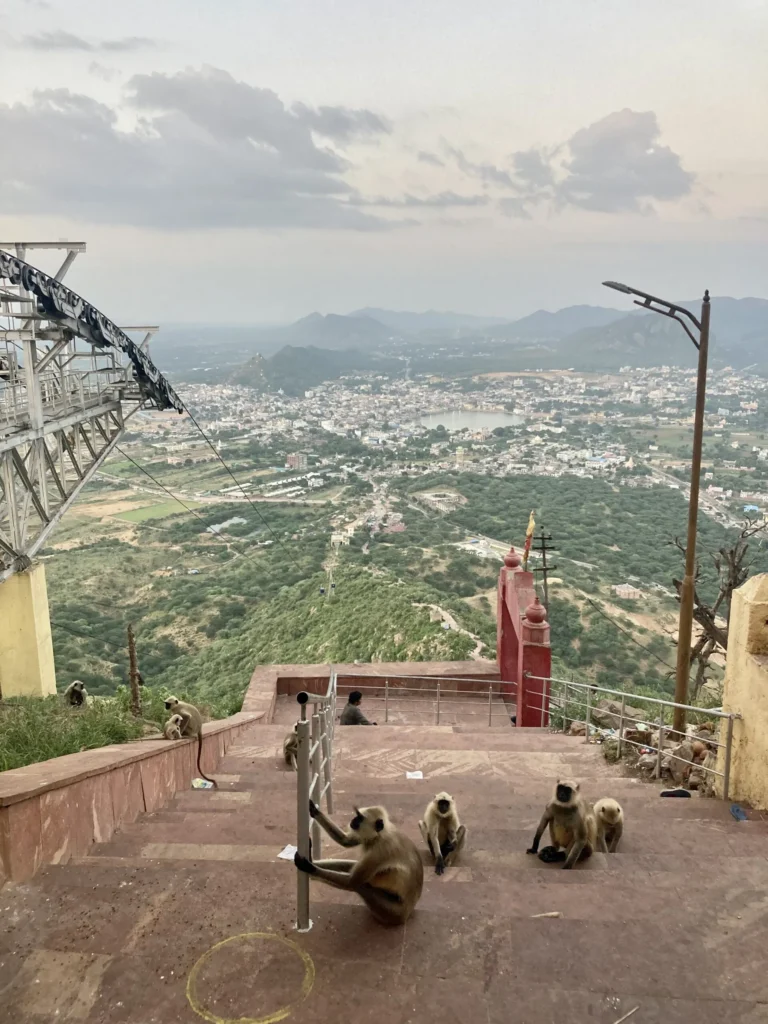 Savitri Temple stairs
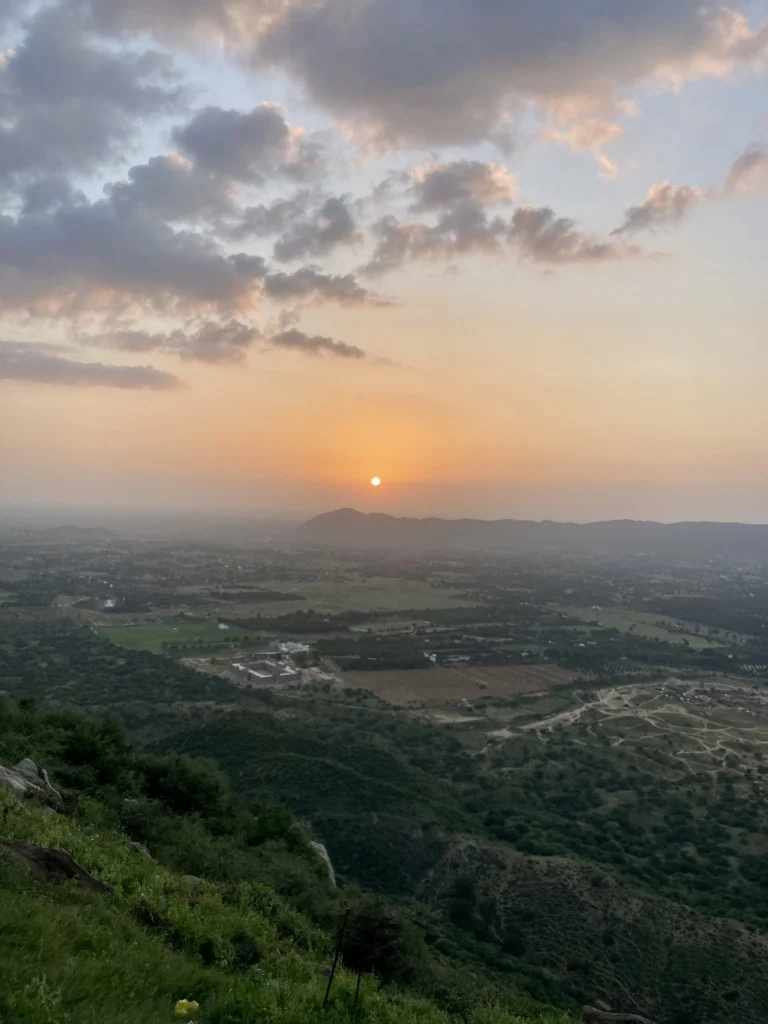 Sunset from Savitri Temple
Bundi: Motorbike Adventure and Cow Cemeteries
After several days of jumping from one big city to another, navigating urban chaos and uncomfortable trains, Bundi felt like opening a window. It welcomed us with a strange calm: quiet alleys, small temples, wall paintings, and a more human pace. It seemed like a town frozen in time, with fewer tourists, less noise, and more curious faces watching us without haste.
We stayed at a simple guesthouse with a great vibe. For breakfast, we went to Sawan Café, which turned out to be a local family’s home converted into a restaurant. They seated us on their terrace and served homemade chai and hot parathas. While we waited for the food, the family’s son—a lad no older than twenty—offered us marijuana with total nonchalance. It wasn’t presented as something clandestine, but almost as if it were part of the menu. We declined, and he just kept chatting about how beautiful the area was. That’s just how things flowed there.
We rented a beat-up motorbike from the guesthouse—no papers, no insurance, and probably no reliable brakes. But it worked. We decided to explore the surroundings on our own, riding through rural roads, sugarcane fields, and giant trees that offered some shade.
It was on one of those unmarked detours that we accidentally stumbled upon a stretch of road we will never forget: on both sides of the path, cow carcasses in various stages of decomposition. Dozens of them. Some were whole; others were already mere skeletons. The smell was unbearable. At first, we thought it was a landfill. Then we understood that, for some reason, this was the place where sick cows—which no one can touch because they are sacred—were taken to die or be abandoned. An open-air cemetery. We rode through quickly and in silence. It took hours to get that image out of our heads.
But the day had other scenes in store for us.
Riding down a lost path, we reached the Bhimlat Waterfalls, a small cascade hidden between cliffs. There was no one there. We sat in the shade of some rocks, listening to the water, eating fruit, and breathing clean air. This finally felt like a different India—rural, silent, and beautiful.
Back in Bundi, we bought some street food to go—a kind of pakoras wrapped in newspaper—and headed to a sort of improvised “stop” right on the highway to catch the bus that, we were told, would take us to Jodhpur.
We waited for over two hours under the sun. The bus never showed up. The dust, the noise of trucks speeding by, and the uncertainty began to take their toll. We ended up returning to the city with a mix of frustration and resignation. That night we slept poorly, half-irritated and half-exhausted from having to improvise every single moment.
But India has its own way of balancing the chaos: the next morning, an unexpected sleeper bus appeared—comfortable, clean, with air conditioning and soft mattresses. We didn’t have a ticket, but the driver made room for us. It felt like a gift.
We left Bundi with mixed feelings: a place where hospitality and death coexisted without contradiction. Where breakfast tasted like home and the landscape felt like something both sacred and wild at the same time.
Jodhpur: Heatwave and Fortresses
We arrived in Jodhpur in the middle of a brutal heatwave. The thermometer hit 45°C (113°F), and the entire city seemed to be melting under a layer of dust and sun. The moment we stepped off the bus, the air burned. We walked a few meters through the downtown streets looking for shade, but not even the buildings offered relief. Everything was heat, noise, sweat, and more heat.
Desperate for a place to take cover, the only air-conditioned spot we found was a McDonald’s. It wasn’t what we had imagined for our first meal in the “Blue City,” but at that moment, it didn’t matter. We went in, sat right under the blast of cold air, and recovered our strength with a spicy chicken combo and an ice-cold Coke. For a few minutes, India stopped being India, and we were just two travelers taking refuge from the outside world.
In the afternoon, as the sun began to drop, we headed up to Mehrangarh Fort, an imposing fortress that rises above the city as if floating over the chaos. From the top, Jodhpur unfolded at our feet like a blue carpet, with thousands of houses whitewashed in different shades extending in every direction. It’s easy to see why they call it the “Blue City”: from up there, it looks like a sea of rooftops. Light blue, electric blue, dirty blue… all mixed with antennas, hanging laundry, and makeshift roofs.
The sunset from the fort was one of the most beautiful of the trip. The sky turned orange, and the wind, finally, began to blow a little. We sat on a corner of the wall in silence, no words needed. We were tired, dirty, and a bit overwhelmed, but also struck by the unexpected beauty of that place.
At night, we looked for a place with a terrace for dinner and found a modest rooftop with views of the entire illuminated fort. We ordered something light, still affected by the heat, and ate while the night breeze brought some relief. There were moments of silence. It was as if Jodhpur, at nightfall, decided to let its visitors rest too.
The next day, Maria woke up feeling ill. Stomach pain, weakness, dizziness. Most likely the heat, the food, or simply the accumulated exhaustion. She stayed in the room resting while I went out to buy water, fruit, and some basic medication.
That afternoon, we caught a train back to Delhi. There is no nice way to put it: it was the worst journey of the trip. The carriage was packed, filthy, and the air didn’t circulate. The heat was unbearable again, and at every stop, more people squeezed in. The aisle filled with bodies, suitcases, crying children, chai vendors, and people sleeping on the floor. Maria was pale, and my only thought was getting there as soon as possible.
Sometimes, when you’re traveling, you reach a point where you don’t want any more adventure. You just want a clean bed, silence, and cold water.
That was our state of mind on that train.
Back to Delhi and More Poverty
Returning to Delhi after traveling through Northern India was like coming full circle, but it also felt like falling back into that initial vertigo. We already knew the chaos, the noise, the filth, and the heat. This time, however, something had changed: us.
We strolled through Main Bazar, one of those places where India shows itself without a filter. The streets are packed with food stalls, sari shops, European backpackers, barefoot children begging, cows blocking the way, and tuk-tuks passing inches away from it all. By day, it’s chaos. By night, it’s an illuminated chaos. Everything glows with neon lights: pharmacies, restaurants, fake jewelry shops, and the flickering signs of guesthouses.
Jaime decided to try some street food. A man was cooking skewers over charcoal on a rusted grill, and when he served them, he wrapped them—literally—in a recycled Ariel laundry detergent envelope. The curry mixed with the smell of cardboard and dry detergent. The absurdity of the moment made us laugh… but it also made us look at our surroundings with more focus.
One of those days, we decided to visit an exclusive mall in South Delhi. The contrast of the journey alone was overwhelming: we went from dusty, crowded neighborhoods to clean, landscaped avenues surrounded by high walls. The mall entrance had metal detectors, armed guards, and an almost visual entry filter, as if they were evaluating whether you looked Western or wealthy enough to enter.
Inside, the air conditioning hit us like a revelation. It was another world. Luxury stores, cafes with frappuccinos, Zara, H&M, glittering jewelry shops, children in strollers with iPads, and young couples dressed like they stepped out of Instagram. We didn’t know whether to feel relieved or uncomfortable. India revealed its most brutal inequality there: what we had experienced outside, in the streets of Main Bazar, seemed to have no connection to this place.
We ate at Madan Café, a backpacker restaurant that felt like a sanctuary amidst the madness. Wooden tables, squeaky fans, ridiculous prices, and massive portions. We ordered thali, paneer, and naan, leaving with full bellies for less than the price of a coffee in Spain.
The last day was quiet. We walked the streets one last time, bought a few souvenirs without much conviction, and sat on the guesthouse terrace watching the sun go down among wires, birds, and the incessant roar of cars. The India we had hated at first was now hard to leave.
The next morning, we left for the airport with that mix of feelings that only a deep, uncomfortable, and revealing trip can leave you with. India had pulled us out of our comfort zone, faced us with the essentials, and taught us how fragile—and privileged—we are.
At the metro station to the airport, our cards wouldn’t work. We had spent all our cash, and there were no other payment options. The ticket was barely 50 cents, but without paying, we couldn’t board. We were stuck in front of the machine, sweating, tired, looking around not knowing what to do.
And then, an Indian man who had observed everything approached us in silence. He smiled, reached into his pocket, and without a word, handed us two tickets to the airport. We accepted with gratitude and a bit of embarrassment. He barely looked at us; he just nodded and walked away.
It was the most humble and generous parting gesture we could have received from a country that had exhausted, overwhelmed, surprised, and taught us so much.
India said goodbye to us exactly as she is: chaotic, unpredictable… and profoundly human.
Final Reflection
India is not just any destination. It is chaos, noise, intensity, spirituality, discomfort, and beauty—all at once. Nothing is neutral. You either hate it or it fascinates you. And for us, it made us feel everything at the same time.
From open-air crematoriums to fortresses atop mountains, from flooded ghats to waterfalls in the middle of nowhere. We will never forget the smells, the colors, the piercing stares, the unexpected hospitality, and everything we learned from every difficult situation.
Namaste, India.